
From Concept to Classroom: Navigating Educational Video Services and Their Costs

Why Educational Video Services Are Changing Learning Today

Educational video services provide professional production support to create engaging video content for learning environments—from K-12 classrooms to corporate training programs. These services typically include:
Pre-production planning: concept development, scriptwriting, and instructional design
Production: live-action filming, animation, voiceover recording, and visual effects
Post-production: editing, graphics, quality assurance, and accessibility features
Distribution support: platform integration, formatting, and optimization
Key benefits: Studies show that learners retain only about 50% of information when they simply hear it, but retention rates jump to 90% when visuals like animated videos are included. Educational videos simplify complex topics, enable self-paced learning, and create emotional connections that make learning stick.
The shift from static textbooks to dynamic video content isn't just a trend—it's a fundamental change in how we learn. Whether you're building a curriculum for students, training employees, or educating customers, video has become the most effective tool for engagement and retention.
But navigating educational video production can feel overwhelming. This guide will help you understand video types, production timelines, budgeting, and how to find the right partner to bring your vision to life.
This guide breaks down everything you need to know about educational video services—from understanding the different types of videos available to decoding production timelines and costs. You'll learn how animation transforms abstract concepts into visual stories, why interactive elements boost engagement, and what questions to ask when evaluating production companies.
I'm Lucas Simmons. With years of experience in video production and instructional design at Gener8 Media, I've helped organizations use educational video to achieve real results. In this guide, I'll share insights and real-world examples to help you make informed decisions about your educational content.

Why Video is a Game-Changer for Modern Learning
Imagine trying to explain quantum physics with just a whiteboard, or teaching a new software program by simply reading a manual. It sounds daunting, right? That's because our brains are wired for visual and auditory input. Video taps into both, creating a rich, multi-sensory learning experience that text alone can't match.

At Gener8 Media, we've seen how high-quality educational videos can transform learning. They don't just convey information; they inspire curiosity and deliver clarity.
The Science of Seeing and Learning
The human brain processes visual information much faster than text. When we combine compelling visuals with clear audio, we engage more parts of the brain, leading to better comprehension and recall. This is where educational video services truly shine.
Improved Engagement: Engaging content, built on learning design best practices and focused on specific outcomes, is one of the most powerful ways people learn today. Video grabs attention and holds it.
Improved Knowledge Retention: As the statistics show, including visuals can boost retention rates to a remarkable 90%. Learners retain more information from video content than from text and static images alone.
Simplifying Complex Topics: Video excels at explaining complex subjects. We can break down intricate processes, abstract concepts, or historical events into digestible, easy-to-follow narratives.
Flexibility and Self-Paced Learning: Educational videos empower learners to digest information at their own pace. They can pause, re-watch sections, and share content, making learning accessible and convenient.
Emotional Connection: Learning is most effective when content connects both logically and emotionally with the audience. Educational video production is about building that emotional connection, not just delivering facts. It helps learners connect with the "why" behind the "what."
The Fun, Visual Way to Learn and Retain Knowledge: Our content is designed to be both educational and entertaining, ensuring that learning feels like an adventure. When storytelling, animation, voiceover, and music come together, learners don't just absorb content—they engage with it.
Studies consistently show that learners retain more information from video. This combination of visual and auditory learning supports cognitive processes from comprehension to critical analysis, leading to changed behavior. Educational video platforms are boosting scores, with some studies showing students are over twice as likely to meet grade-level standards with video-rich resources.
Benefits Across Different Learning Environments
The versatility of educational videos makes them invaluable across a wide spectrum of learning environments:
K-12 Curriculum: From animated explainers for elementary math to historical documentaries for high school, videos align with educational standards and bring subjects to life.
Higher Education Modules: Supporting college-level courses with in-depth lectures, lab demonstrations, and case studies, higher education modules benefit immensely from video.
Corporate Training and Onboarding: Companies use educational video services to efficiently train employees, onboard new hires, and upskill their teams. This includes everything from compliance training to leadership development.
Customer Education: Product tutorials, how-to guides, and explainer videos help customers understand and maximize the value of products and services.
Employee Upskilling: Keeping employees current with new technologies and industry best practices is crucial. Video-based learning offers an engaging way to facilitate continuous professional development.
Exploring the Spectrum: Types of Educational Videos
The right type of educational video depends on your learning objectives, audience, and content complexity.

Here at Gener8 Media, we pride ourselves on our diverse capabilities in educational video production:
Live-Action Instructor-Led Videos: Featuring subject matter experts or instructors, these videos offer a personal touch, perfect for conveying expertise and building rapport. Think of them as a dynamic classroom lecture.
Screencasts and Tutorials: Ideal for software demonstrations, step-by-step guides, or explaining digital processes, these videos capture on-screen actions with clear voiceovers.
Interview Video Production: Capturing insights from experts, testimonials from successful learners, or real-world perspectives can add credibility and depth to your educational content. Learn more about our Interview Video Production services.
Interactive Videos with Quizzes: These go beyond passive viewing, embedding clickable elements, quizzes, and other features to improve learner engagement and test comprehension.
Documentary-Style Content: For deeper dives into topics, historical context, or real-world applications, documentary-style content can be incredibly compelling. Explore our expertise in Documentary Film Production and working with a Documentary Production Company.
The Unique Advantages of Animation
Animation plays a pivotal role in modern educational video services, especially when dealing with complex or abstract subjects.
Explaining Abstract Concepts: Animation can visualize concepts that are impossible to film in live-action, such as the flow of electricity, cellular processes, or historical events. It simplifies complex ideas and fosters deeper understanding.
Character Animation: Using relatable characters can make learning more engaging, especially for younger audiences. Check out our Character Animation Studio to see how we bring stories to life.
2D Animation: A versatile and cost-effective option, 2D animation can transform text-based scripts into visually engaging lessons.
3D Animation: For a more immersive and detailed visual experience, 3D animation can be used to create realistic models and environments. Find our 3D Animation Services and how we use 3D Animations to improve learning. We also offer 3D Animation for Games which can be adapted for educational simulations.
Whiteboard Animations: These dynamic videos illustrate concepts as if drawn in real-time, holding attention and guiding the viewer through information.
Motion Graphics Animation: Adding animated text, icons, and data visualizations can reinforce key educational concepts and make information more engaging. Explore our Motion Graphics Animation services.
Visualizing the Impossible: Animation allows us to create worlds and scenarios that don't exist, making it an unparalleled tool for educational storytelling.
Tailoring Content for Young Learners: Kids' educational animations are designed to captivate younger audiences, using color, character, and pacing to make learning joyful and accessible.
The Rise of Immersive and Interactive Content
The future of educational video services is increasingly immersive and interactive. These technologies create highly engaging experiences that can simulate real-world scenarios or allow learners to explore concepts in new ways.
Virtual Reality (VR) Experiences: Learners can step into virtual environments, from historical battlefields to microscopic worlds, for truly immersive training.
Augmented Reality (AR) Overlays: AR overlays digital information onto the real world, ideal for interactive textbooks or on-site training.
360-Degree Immersive Videos: These videos place the learner at the center of the action, allowing them to look around a scene as if they were there.
Gamification Elements: Integrating game-like challenges, rewards, and progress tracking can significantly boost motivation and engagement.
Immersive Content Creation: Our expertise in Immersive Content Creation allows us to build these cutting-edge educational experiences.
XR Production: Extended Reality (XR), encompassing VR, AR, and mixed reality, is at the forefront of immersive learning. At Gener8 Media, our XR Production Studio is equipped to develop these next-generation educational tools.
From Script to Screen: The Educational Video Production Journey
Creating an effective educational video is a meticulous, multi-stage process. Understanding this journey ensures a smooth collaboration with your production partner and helps you appreciate the effort involved.
The typical production turnaround time for an educational video can range from weeks to months, depending on its complexity and length. On average, a project might take 4 to 8 weeks from concept to completion, with larger series potentially spanning 3 to 6 months or longer.
Phase 1: Pre-Production and Planning
This is where the blueprint for your educational video is created. It’s arguably the most critical phase, as solid planning prevents costly revisions down the line.
Concept Development: We start by defining your core message, target audience, and what you want learners to know or do after watching.
Learning Objectives: Aligning video content with clear learning objectives is paramount. We work closely with you during the findy phase to ensure the video delivers the intended educational outcomes.
Documentary Script Writing: Our team crafts a compelling narrative that simplifies complex information while maintaining accuracy. Our Documentary Script Writing expertise is ideal for in-depth content.
Storyboarding: This visual roadmap illustrates each scene, shot, and animation, ensuring everyone is aligned on the visual flow and narrative.
Instructional Design: We integrate learning design best practices to structure content for maximum comprehension and retention.
Casting and Location Scouting: If live-action is involved, we handle casting the right talent and finding suitable locations in Northern California that improve your message.
Pre-visualization Animation: For complex sequences, we can create rough animated versions to visualize the final product before full production begins, saving time and resources. Learn more about Pre-visualization Animation.
Phase 2: Production and Content Creation
With a solid plan in place, we move into bringing the script and storyboard to life.
Live-Action Filming: Our team uses state-of-the-art equipment and filming techniques to capture high-quality footage.
Voiceover Recording: Professional voice artists record the script, ensuring clear, engaging, and appropriately toned narration.
Animation Creation: Our animators get to work, crafting 2D, 3D, whiteboard, or motion graphics elements as planned.
Visual Effects Animation: For specialized needs, our Visual Effects Animation expertise adds an extra layer of polish and impact.
Sound Design Production: Sound effects and music are crucial for setting the mood and reinforcing key moments. Our Sound Design Production ensures a rich auditory experience.
Subject Matter Expert Collaboration: Throughout this phase, we maintain close collaboration with your subject matter experts to ensure the accuracy and integrity of the content.
Phase 3: Post-Production and Quality Assurance
This is where all the raw elements come together to form the final educational video.
Editing and Assembly: Our editors carefully piece together footage, animation, and audio to create a cohesive and engaging narrative.
Graphics and Effects: Motion graphics, text overlays, and other visual effects are integrated to improve understanding and visual appeal.
Advanced Media Production: Leveraging our capabilities in Advanced Media Production, we apply sophisticated techniques to refine the visual and auditory experience.
Content Accuracy Checks: Rigorous fact-checking and script reviews are performed to validate content accuracy and adherence to educational industry standards.
Client Review and Feedback Cycles: We involve you in structured review cycles at every phase (script, storyboard, animation, sound) to ensure the final product meets your expectations.
Accessibility Features: Captions and Transcripts: To ensure inclusivity, we integrate features like closed captions, descriptive audio, and transcripts, making content accessible to all learners.
More about the video post-production process: For a deeper dive into this crucial stage, you can explore resources like Adobe's guide on video post-production.
Distribution and Integration: Finally, we guide you on distributing your video content to maximize impact and reach. We can format and optimize your educational videos for seamless integration with your learning management systems (LMS) or other online platforms.
Decoding the Investment: What Do Educational Video Services Cost?
The investment in educational video services varies significantly based on project size, features, and customization.
Key Factors That Influence Your Budget
Several factors play a role in determining the overall cost of your educational video project:
Scope of the Project: Are you producing a single explainer video or a comprehensive series of modules? The number of videos and modules directly impacts the cost.
Video Length and Complexity: A short, simple animated explainer will cost less than a longer, highly detailed 3D animation or a complex live-action shoot with multiple locations and actors.
Animation vs. Live-Action: Animation offers immense flexibility but can be labor-intensive. Live-action can be more cost-effective for "talking head" style videos but can quickly increase with talent, locations, and equipment needs.
Talent and Equipment: Professional actors, voiceover artists, specialized camera gear, and advanced software all contribute to the production value and, consequently, the cost.
Level of Customization: Highly customized graphics, characters, or interactive elements require more design and development time.
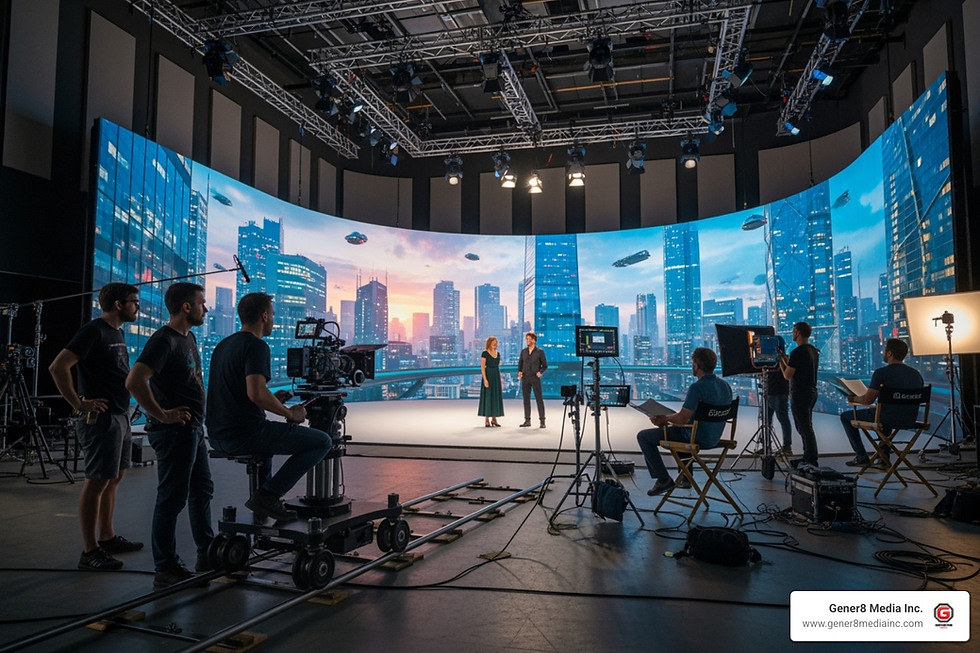
Use of Advanced Technology like VR/XR: Leveraging cutting-edge technologies such as virtual production, VR, or AR for immersive experiences, while incredibly impactful, will also increase the budget due to specialized expertise and equipment. Learn more about Unlocking the Power of Virtual Production in California.
Timeline and Deadlines: Expedited timelines often require additional resources, which can affect the overall cost. We pride ourselves on our flexibility to meet your timeline, however pressing it might be.
Licensing and Distribution Rights: Costs for stock footage, music licenses, and specific distribution rights may also be part of the budget.
Understanding Pricing Models
Educational video production companies often use various pricing models:
Per-Video Pricing: Common for shorter, standalone videos with a defined scope.
Per-Minute Pricing: Many animation studios, for instance, quote based on the finished minute of video. For simple motion graphics, full-cycle development can start around $650 per minute. More complex 2D animations might range from $1,000 to $2,000 per minute, while studio live-action "talking head" videos average $60–$110 per finished minute.
Project-Based Retainers: For ongoing content needs or large-scale projects, a retainer model can be more cost-effective.
Bulk Production Discounts: If you have a series of videos, many companies offer discounts, as a longer total runtime often results in a lower cost per minute.
Here's a simplified overview of how costs can vary:
Video Type | Complexity Level | Estimated Cost Per Minute (USD) | Key Characteristics |
Remote/AI Talking Head | Simple | $25 - $75 | Basic presenter, minimal graphics, often AI-generated. |
Studio Live-Action | Simple to Moderate | $60 - $110 | Professional presenter, basic studio setup, some graphics. |
Simple Motion Graphics | Moderate | $650+ | Basic animated text, icons, transitions, no complex character animation. |
Simple Character/Infographic | Moderate to High | $700 - $1,000 | 2D character animation, infographic elements, script, and storyboard included. |
Advanced 2D Animation | High | $1,000 - $2,000 | Detailed 2D characters, custom backgrounds, complex scene transitions, advanced storytelling. |
Complex 3D Animation/VR | Very High | $2,000+ | Highly detailed 3D models, complex simulations, virtual reality environments, specialized software and talent. |
Note: These are estimated ranges and can vary significantly based on studio, region, and specific project requirements.
Choosing the Right Partner for Your Educational Content
Selecting the right partner for your educational video services is crucial. You need a team that understands learning, storytelling, and how to translate complex ideas into engaging visual content.
Evaluating a Company's Portfolio
A company's portfolio is a window into their creative prowess and capabilities.
Diversity of Work: A quality portfolio should be diverse and exhibit a high level of craftsmanship. Look for examples that show a range of styles, subjects, and target audiences.
Craftsmanship and Production Value: Pay attention to the quality of animation, cinematography, sound design, and editing. Does it look professional and polished?
Relevance to Your Industry: While versatility is good, seeing projects similar to yours (e.g., in K-12, higher education, or corporate training) indicates relevant experience.
Case Studies and Results: Look for evidence of impact. Did their videos achieve specific learning outcomes or engagement goals for previous clients?
Key Factors in Selecting an Educational Video Services Provider
Beyond the portfolio, consider these critical elements:
Technical Expertise: Does the team have the technical skills and equipment to execute your vision? This includes expertise in everything from advanced camera systems to animation software and virtual production tools.
Industry Experience: Look for a company with a proven track record. For example, some companies have over two decades of experience in educational video production, while others have successfully completed over 1,200 projects.
Communication and Collaboration: The production process is highly collaborative. A good partner will establish clear communication channels and welcome your input and feedback throughout.
Client Reviews and Testimonials: Positive client reviews and testimonials are strong indicators of reliability and client satisfaction.
Understanding of Learning Design: An effective educational video services provider should understand instructional design principles and how to structure content for maximum learning impact.
Expertise in Specific Technologies: If you're aiming for cutting-edge content like VR/AR or 3D animation, ensure your partner has proven expertise in these areas. Gener8 Media prides itself on leveraging cutting-edge technology like virtual production and 3D animation to transform diverse visions into immersive experiences.
Ability to Scale Production: If you anticipate needing a large volume of videos, ensure your partner can scale their resources. Some companies specialize in producing educational videos at scale, handling projects involving hundreds or even thousands of videos.
Alignment with Your Learning Objectives: The production company should work closely with you during the findy phase to understand your learning objectives and ensure the video content aligns with your goals.
Professional Video Services: You need a partner who offers comprehensive Professional Video Services that cover every aspect of your project.
Frequently Asked Questions about Educational Video Production
We often get asked similar questions about educational video services. Here are some of the most common ones, with answers to help clarify the process:
How can educational videos be integrated into existing learning platforms?
We ensure seamless integration with your existing infrastructure by:
Formatting Videos for Any Learning Management System (LMS): Our team can format and optimize your educational videos for seamless integration with your learning management systems (LMS) or other online platforms. This includes ensuring compatibility with SCORM (Sharable Content Object Reference Model) standards, a common e-learning specification.
API Integration for Popular Platforms: For advanced needs, we can work with your developers to facilitate API (Application Programming Interface) integration, allowing for dynamic content delivery and tracking within platforms.
Embedding on Websites and Internal Networks: Videos can be easily embedded into your website, internal knowledge bases, or company intranets, making them accessible where your learners already are.
Making learning captivating for every student, everywhere: The goal is always to make the content accessible and engaging, regardless of the platform.
How do you ensure educational content is accurate and high-quality?
Accuracy and quality are non-negotiable. Our approach includes:
Collaboration with Subject Matter Experts (SMEs): We work closely with your subject matter experts throughout the entire process, from script development to final review, to ensure factual correctness.
Meticulous Research and Fact-Checking: Our team conducts thorough research and fact-checking to support all content claims and data presented in the videos.
Rigorous Script Review Process: Scripts undergo multiple rounds of review, both internally and with your team, to ensure clarity, accuracy, and alignment with learning objectives.
Multi-Stage Quality Control and Testing: From initial storyboards to final edits, we implement rigorous testing and quality assurance checks to validate content accuracy and technical quality.
Adherence to Educational Standards: We adhere to educational industry standards and best practices, and can ensure content is curriculum- and standards-aligned, such as with Common Core or Next Generation Science Standards, if required.
How can videos be custom for different age groups?
We customize videos for different age groups to maximize engagement by adjusting:
Content is Customized for Specific Curricular Needs: Whether it’s K-12, higher education, or adult professional development, we adapt content to suit the age, curriculum, or specific learning context of the audience.
Tone, Pacing, and Visuals are Adjusted: For younger audiences, we use brighter colors, faster pacing, and simpler language. For adults, the tone might be more formal, the pacing slower, and the visuals more sophisticated.
Use of Relatable Characters for Younger Audiences: Kids' educational animations, for example, often feature relatable characters and playful narratives to make learning joyful and accessible.
Complexity of Language and Concepts for Adult Learners: While we simplify for younger learners, for adults, we can dive deeper into complex concepts and use specialized terminology when appropriate.
Here are some customization options we consider:
Character design: From cartoon animals for preschoolers to realistic avatars for corporate training.
Music selection: Upbeat and playful for children, professional and inspiring for adults.
Narrative style: Direct instruction, storytelling, problem-solving scenarios, or case studies.
Interactive elements: Simple click-and-drag for kids, complex simulations or branching scenarios for older learners.
Conclusion
The learning landscape is evolving, and educational video services are at the forefront. We've explored how video boosts engagement and retention, the vast possibilities from animation to VR, and the production journey from concept to screen. We've also detailed the production phases and the factors that influence project costs.
Choosing the right production partner is paramount. It requires evaluating their portfolio, technical expertise, understanding of learning design, and commitment to quality and accuracy.
At Gener8 Media, based in Northern California, we understand the power of compelling visual storytelling in education. Our expertise in leveraging cutting-edge technology like virtual production and 3D animation allows us to transform diverse visions into immersive educational experiences that resonate deeply with learners.
By taking a strategic approach and partnering with a skilled production team, you can create educational content that not only meets your objectives but also truly inspires and empowers your audience. We're here to help you harness the full potential of video for your learning initiatives.
Ready to revolutionize your educational content? Let us help you create videos that not only meet your standards but also engage learners and deliver real results. Explore how we can Elevate Your Projects with Gener8 Media's Expertise.


Comments