
The Art of Illusion: A Guide to Visual Effects Animation

What Visual Effects Animation Really Means

Visual effects animation is the art of creating or enhancing moving images with digital techniques that would be impossible, dangerous, or too expensive to capture in real life. It combines several key disciplines:
Animation: Creating characters and movement from scratch.
Visual Effects (VFX): Adding digital elements to live-action footage.
Integration: Seamlessly blending real and computer-generated imagery.
Post-Production: Most work happens after filming is complete.
Common applications range from explosions and fantasy creatures in action movies to creating historical settings or removing unwanted elements from a scene. The magic happens when artists combine traditional artistic skills with cutting-edge technology, making visual effects animation essential to modern storytelling.
From the early "stop trick" techniques of the 1890s to today's photorealistic CGI, this field continues to push creative boundaries. As one of the fastest-growing creative sectors, the global animation and VFX industry is a multi-billion dollar powerhouse. Understanding it means grasping both the creative vision and the technical execution that bring impossible worlds to life.
Animation vs. Visual Effects: Understanding the Core Differences
While visual effects animation sounds like a single discipline, it’s a partnership between two key fields: 3D animation and visual effects (VFX). Though they often work together, understanding their differences is key to appreciating movie magic.
3D animation is about building a new world from scratch. Every character, prop, and environment is created digitally, as seen in films like Toy Story or Spider-Man: Into the Spider-Verse. Artists act as digital architects, crafting entire universes and bringing them to life.
Visual Effects (VFX), on the other hand, improves or alters existing live-action footage. VFX artists add digital magic—like a soaring dragon or a massive explosion—to scenes filmed with real cameras and actors, blending the impossible seamlessly into our world.
Here’s a quick comparison:
Feature | 3D Animation | Visual Effects (VFX) |
Purpose | To create entire animated sequences, characters, and worlds from imagination. | To improve or manipulate live-action footage by adding digital elements. |
Process | Building digital models, rigging them for movement, and then keyframing or motion-capturing their actions. | Integrating computer-generated imagery (CGI) with live-action plates through techniques like compositing, match-moving, and rotoscoping. |
Input | Concepts, storyboards, character designs. | Live-action footage (plates), concept art for digital additions. |
Output | Fully animated characters, objects, or scenes that stand alone. | Seamlessly blended digital elements within live-action footage, making the impossible look real. |
Primary Goal | To tell a story through entirely computer-generated visuals. | To make filmed scenes more impactful, realistic, or fantastical without breaking immersion. |
Key Skillset | Artistic anatomy, performance, timing, storytelling through movement. | Technical integration, photorealism, problem-solving, understanding of light and physics. |
The Evolution of Visual Effects and Animation
The history of visual effects animation is a journey of constant innovation. It began with simple photo compositing in 1857 and the first movie special effect in 1895, which used the 'stop trick' to simulate a beheading. The true pioneer was Georges Méliès, a magician who used stop tricks, multiple exposures, and hand-painted color to create fantastical films like 1902's A Trip to the Moon.
He combined early animation with miniature models and matte painting—a technique where artists painted backgrounds on glass to create expansive worlds. You can explore this fascinating history in this historical look at matte painting.
The real game-changer was the digital revolution. Computer-generated imagery (CGI) in the late 20th century, showcased in films like Terminator 2 and Jurassic Park, opened up a new world of possibilities. Today, modern animation relies heavily on CGI to make impossible visuals an everyday reality in movies, TV, and web series.
How Practical and Digital Effects Complement Each Other
Movie magic isn't always digital. The best results often come from a team-up between digital effects (VFX) and practical effects, also known as special effects (SFX). SFX are the physical wonders that happen on set: controlled explosions, animatronic creatures, or atmospheric effects like rain and snow. They provide a tangible, grounded reality for actors to interact with.
VFX comes in after filming to add what's impossible or too dangerous to create physically, like a spaceship landing or a sunny day turning into a hurricane. Filmmakers blend these techniques to get the best of both worlds. Practical effects offer weight and realism, while VFX provides limitless scale and safety. This clever teamwork, which we practice at Gener8 Media Inc., ensures the final scene is as immersive and believable as possible. See how we bring these concepts to life in our work in films.
The VFX Production Pipeline: From Concept to Final Render
Bringing incredible visual effects to the screen is a highly structured journey called the VFX production pipeline. It’s a carefully planned workflow that ensures consistency and delivers stunning visuals. The process is broken down into three main stages: Pre-Production, Production, and Post-Production.

This organized approach is essential for managing complex data, making artistic choices, and solving technical challenges to turn a director's vision into a captivating reality.
Stage 1: Pre-Production
This planning stage happens long before cameras roll. It's about laying the groundwork for all visual effects.
Concept Art: Artists create illustrations to establish the look and feel of characters, environments, and effects.
Storyboarding: Key scenes are drawn frame-by-frame to map out camera angles, character actions, and VFX placement.
Pre-visualization (Pre-vis): Rough 3D animations of complex sequences are created to test camera movements, timing, and choreography, helping to identify challenges early.
VFX Supervisor: This key person works with the director from the start to plan the creative and technical approach for all effects, ensuring the vision is achievable within budget.
Planning: The script is broken down into VFX shots, with budgets, schedules, and teams assigned to each task.
Stage 2: Production
During the live-action shoot, the goal is to capture all the elements needed for post-production. Though most visual effects animation happens later, this stage is vital for gathering the raw materials.
On-Set Supervision: The VFX Supervisor and their team ensure footage is shot correctly for adding digital elements later, advising on camera settings, lighting, and green screen setups.
Green/Blue Screen: Actors are filmed against a uniformly colored background, which can be easily removed in post-production and replaced with a digital environment.
Motion Capture (Mo-cap): Actors in special suits have their movements recorded. This data is then used to animate 3D digital characters for incredibly lifelike performances.
Data Acquisition: The team collects technical information from the set, including camera lens details, lighting data, and measurements of props and sets.
Match-moving: This process tracks the live-action camera's movement, allowing a digital camera to replicate it. This ensures that CGI elements fit perfectly into the scene with the correct position, scale, and motion.
Stage 3: Post-Production
This is where the bulk of the visual effects animation work happens, changing all the collected assets into the final visuals.
Modeling: 3D artists build the digital assets—characters, props, and environments—that will appear in the shots.
Texturing: Artists paint detailed surfaces onto the 3D models to define their color, texture, and material properties, making them look realistic.
Rigging: A digital “skeleton” is built for 3D models, allowing animators to pose and move them.
Animation: Animators bring the rigged models to life, creating believable movement and performances.
Compositing: All separate elements—live-action footage, 3D renders, and special effects—are combined into a single, seamless image. For more on this complex process, see this academic paper on Digital Compositing.
Rendering: The computer processes all the data to produce the final, high-resolution image frames.
At Gener8 Media Inc., our expertise in 3D Animations and post-production ensures every detail contributes to an immersive experience.
The Artist's Toolkit: Key Techniques and Software
Creating stunning visual effects animation requires a blend of artistic vision and technical skill. Artists use a variety of digital tools and techniques to make the impossible look believable, serving the creative needs of the story.

Core Techniques Explained
Compositing: This is the art of blending multiple visual elements—like live-action footage, 3D models, and digital paintings—into a single, seamless image. The key is to perfectly match lighting, color, and perspective.
Motion Tracking: Also known as match moving, this technique analyzes camera movement in live-action footage and applies it to digital elements, ensuring they feel grounded in the scene.
Rotoscoping: This involves tracing objects or characters frame by frame to separate them from their background. It's essential when a green screen isn't used or for isolating complex shapes like hair.
Matte Painting: Digital artists create photorealistic environments, from historical cities to alien landscapes, that extend the physical set and are seamlessly integrated into the shot.
Dynamics and Simulation: This technique uses physics-based algorithms to create realistic natural phenomena like fire, water, smoke, and explosions, giving artists control over complex environmental effects.
Industry-Standard Software Categories
The software landscape for visual effects animation is always evolving, but professionals rely on several key types of tools.
3D Modeling and Animation Software: These applications are the foundation for building and animating everything from characters and creatures to vehicles and environments.
Compositing Software: This is where all the visual layers are combined. These tools specialize in color matching, layering, and integrating 2D and 3D elements into a final, cohesive shot.
Simulation and Effects Software: These specialized tools are used to generate realistic fire, water, cloth, and destruction, using advanced physics to mimic real-world behavior.
Sculpting Software: Much like working with digital clay, these applications allow artists to sculpt highly detailed organic models, such as characters and creatures, with incredible realism.
Mastering these tools allows artists to transform creative visions into the stunning visuals that captivate audiences worldwide.
Careers and Skills in Visual Effects Animation
The visual effects animation industry is a booming playground for creative minds who love blending art with technology. Opportunities span blockbuster films, streaming series, video games, and advertising. As one of the fastest-growing creative sectors, it's an exciting career path for those who dream of creating the next iconic movie monster or designing breathtaking virtual worlds.

Key Roles and Responsibilities
Working in VFX means specializing in a particular area of the production pipeline. Here are some key roles:
VFX Artists: Generalists or specialists who create digital effects like fire, smoke, and water, integrating them into live-action shots.
3D Animators: They bring 3D models to life, creating believable movement and performances for characters and objects.
Compositors: These artists are the final assemblers, blending all visual elements (live-action, CGI, etc.) into a single, cohesive image.
Rotoscope Artists: They carefully trace elements frame by frame to isolate them from their background, enabling seamless compositing.
Lighting Artists: They illuminate 3D scenes to match live-action footage or create a specific mood, ensuring CGI elements fit perfectly.
Matchmove Artists: Technical artists who track camera and object movement in footage so CGI can be integrated with the correct perspective.
Essential Skills for a Successful Career in Visual Effects Animation
Success in this field requires a blend of artistic talent and technical skill.
Technical Proficiency: Mastery of industry-standard software is a must. Scripting or programming knowledge is a major advantage.
Artistic Eye: A strong understanding of composition, color theory, lighting, and anatomy is crucial for creating compelling visuals.
Problem-Solving Skills: VFX is about solving complex visual puzzles and adapting to new technologies and workflows.
Attention to Detail: The difference between believable and fake often lies in tiny details of light, texture, and movement.
Communication and Teamwork: VFX is highly collaborative. Clearly explaining ideas and working effectively with a team is essential.
Where to Learn and Develop Your Craft
Breaking into visual effects animation is more accessible than ever.
Specialized Training: Colleges and universities offer degrees in animation and VFX, providing structured learning and industry connections.
Industry Workshops: These offer focused, intensive training from working professionals on specific techniques and current practices.
Online Learning Resources: A wealth of tutorials and courses are available online, allowing for self-directed skill development.
Building a Demo Reel: This is your most important asset. A short compilation of your best work is essential for showcasing your abilities to employers.
Networking: Engaging with the VFX community through conferences and online forums is key. Organizations like The Visual Effects Society (VES) are invaluable, offering industry insights and networking opportunities through publications like VFX Voice.
The Future of Illusion: Emerging Trends in the Industry
The world of visual effects animation is in a constant state of evolution, driven by technological breakthroughs and our hunger for more immersive stories. Innovations like real-time rendering and artificial intelligence are not just small improvements—they are fundamental shifts rewriting the rules of visual magic.
The Rise of Virtual Production
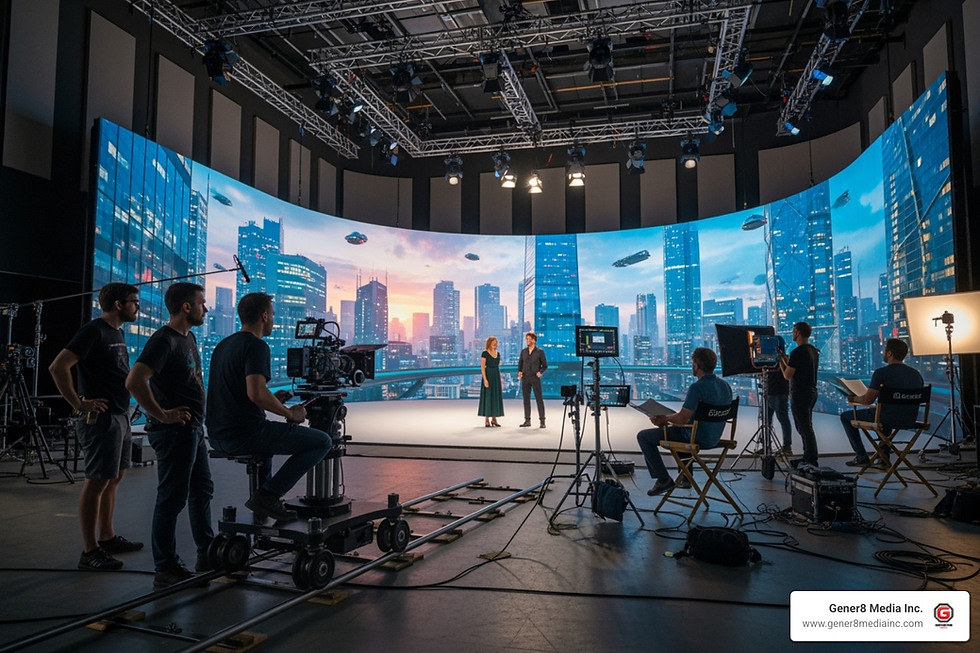
Virtual production is revolutionizing filmmaking, moving beyond the limitations of green screens. This approach uses massive LED walls and real-time rendering engines to bring digital environments directly onto the film set. Actors can see and interact with the virtual world around them, which is projected on enormous, wrap-around LED screens.
This technology is a game-changer because the LED walls emit light, naturally illuminating the actors and props with realistic reflections and shadows. Directors can see a near-final shot in real-time and make creative changes on the fly, like altering the time of day or moving background elements with a few clicks. This on-set compositing capability provides incredible creative freedom and efficiency, often reducing the time and cost of post-production.
At Gener8 Media Inc., we are passionate about this technology. We offer Virtual Production Training and are committed to opening up the Power of Virtual Production in California to help creators master these cutting-edge techniques.
AI's Impact on the Future of Visual Effects Animation
Artificial intelligence is not replacing visual effects animation artists; it's becoming their most powerful assistant. AI is automating time-consuming tasks and open uping new creative potential.
Machine learning is already accelerating tedious processes like rotoscoping (isolating objects) and clean-up (removing wires or markers). This frees up artists to focus on more creative challenges. Meanwhile, generative AI is opening new doors, allowing artists to quickly generate thousands of variations of assets like terrain or textures based on their creative direction.
AI is also improving workflow efficiency by optimizing rendering and helping manage the massive data of modern productions. It's enabling new creative tools for advanced face replacement and AI-assisted animation. The future is a collaboration between human creativity and artificial intelligence, pushing the boundaries of visual storytelling further than ever before.
Conclusion
We've journeyed through visual effects animation, from how 3D animation builds worlds from scratch to how VFX transforms live-action footage. This field perfectly marries artistic vision with technological innovation, a tradition that stretches from the early camera tricks of Georges Méliès to today's virtual production.
The industry has evolved from simple illusions into a sophisticated pipeline offering incredible career opportunities. Looking ahead, the future is even more exciting. Virtual production and AI are not just technological advances; they are tools that empower artists to push creative boundaries further.
At Gener8 Media Inc., based in Northern California, we use this incredible technology to bring visions to life. We believe great visual effects animation is about creative storytelling that connects with audiences. As an essential part of film, television, and digital media, these skills can transform any concept into a compelling visual reality.
Ready to bring your next project to life? We'd love to help you explore the possibilities. Lift your next documentary project with cutting-edge visual storytelling and see how the magic of visual effects animation can lift your story.


Comments