
The Future is Now: A Guide to Immersive Content Creation

Why Immersive Content Creation is Revolutionizing Digital Experiences

Immersive content creation is the process of developing digital experiences that fully engage users' senses and make them feel present in virtual or augmented environments. This technology combines visual, audio, and interactive elements to create compelling worlds that go far beyond traditional media.
Key Components of Immersive Content Creation:
Virtual Reality (VR) - Complete digital environments accessed through headsets
Augmented Reality (AR) - Digital overlays on the real world via smartphones or glasses
Mixed Reality (MR) - Blending physical and digital elements that interact in real-time
360° Video - Spherical footage allowing viewers to look in any direction
The impact is undeniable. Research shows that immersive experiences can increase retention rates by up to 80% compared to traditional methods. They also drive up to 2x the engagement of standard content formats.
This shift isn't just about fancy technology - it's about fundamentally changing how audiences connect with content. As one industry expert noted, "Great brands don't just tell stories. They create experiences."
Whether you're looking to train employees more effectively, showcase products in new ways, or simply captivate your audience like never before, immersive content creation offers unprecedented opportunities to make lasting impressions.
The question isn't whether immersive content will become mainstream - it's how quickly your organization can adapt to harness its power.
Decoding the Immersive Spectrum: From VR to 360° Video
The world of immersive content creation isn't a one-size-fits-all landscape. Think of it more like a spectrum of experiences, each offering its own unique way to captivate and engage your audience. Whether you want to transport someone to an entirely different world or simply improve their current reality with digital magic, there's a perfect immersive solution waiting.

Understanding these different approaches is crucial for choosing the right tool for your project. Let's break down what makes each technology special and when you might want to use them.
The Four Main Types of Immersive Content
Virtual Reality (VR) is the ultimate escape hatch from reality. When you put on a VR headset, you're essentially telling the real world "see you later" and diving headfirst into a completely digital environment. It's full immersion at its finest - you can walk around virtual spaces, pick up digital objects, and interact with computer-generated worlds as if they were real.
This technology requires specialized head-mounted displays like the Meta Quest or Valve Index, often paired with controllers that track your hand movements. The level of user immersion is incredible, making VR perfect for everything from immersive gaming experiences to surgical training simulations.
Augmented Reality (AR) takes a gentler approach. Instead of replacing your world, it decorates it with digital overlays. Think of those fun Snapchat filters that give you virtual sunglasses, or apps that let you see how furniture would look in your living room before you buy it.
AR works through smartphones, tablets, or specialized AR glasses, making it much more accessible than VR. The real-world interaction remains intact - you're still in your environment, just with some digital improvement sprinkled on top.
Mixed Reality (MR) is where things get really interesting. It's like AR's more sophisticated cousin, blending physical and digital elements so seamlessly that virtual objects can actually interact with your real environment. Imagine placing a digital hologram on your coffee table that responds when you walk around it or gesture toward it.
This technology typically requires advanced headsets like the Apple Vision Pro or Microsoft HoloLens. The interaction level is remarkably high, making MR ideal for complex design reviews or collaborative work sessions where teams need to manipulate 3D models together.
360-degree video is the most approachable entry point into immersive content. Using special omnidirectional cameras, creators capture every angle of a scene simultaneously. The result is spherical video that lets viewers look around as if they were actually there.
While you can't freely move around like in VR, 360-degree content offers a compelling "you are there" experience. A perfect example is Google Maps' Street View, which lets you virtually explore locations worldwide by simply dragging your finger or moving your head.
Here's how these technologies stack up against each other:
Aspect | Virtual Reality (VR) | Augmented Reality (AR) | Mixed Reality (MR) | 360-degree Video |
Definition | Complete digital environment replacement | Digital overlays on real world | Real and virtual elements interact | Spherical footage capturing all directions |
Hardware | VR headsets, motion controllers | Smartphones, tablets, AR glasses | Advanced MR headsets | 360° cameras, viewing devices |
Interaction Level | High - full exploration and manipulation | Moderate - overlay interaction | High - real-time mixed interaction | Low to moderate - viewing with hotspots |
Example Use Case | Virtual training simulations | Product visualization apps | Collaborative design sessions | Immersive storytelling experiences |
Each of these technologies serves different purposes and budgets. The key is matching the right approach to your specific goals and audience needs. Whether you're creating training content, marketing experiences, or entertainment, understanding these distinctions will help you make the perfect choice for your next immersive project.
The Technology Powering Immersion
Think of immersive content creation like building a digital magic trick. Behind every jaw-dropping virtual experience is an orchestra of technologies working together seamlessly. At Gener8 Media, we've spent years mastering these tools to turn wild ideas into reality.
The foundation starts with head-mounted displays (HMDs). These aren't just fancy goggles - they're your portal to other worlds. Whether it's a Meta Quest for VR adventures or Apple's Vision Pro for mixed reality experiences, HMDs deliver the visual and audio immersion that makes you forget you're wearing anything at all.
But seeing is only half the battle. Motion tracking sensors are the unsung heroes that make immersive experiences feel natural. They follow every head turn, hand gesture, and body movement, translating your real-world actions into the digital space. Without them, you'd feel like you're watching a movie instead of living inside one.
The real heavy lifting happens in game engines like Unity and Unreal Engine. These powerhouse platforms are where the magic gets built - 3D worlds come to life, physics behave realistically, and user interactions feel responsive. Our team uses these engines for everything from 3D animations to complex virtual productions.
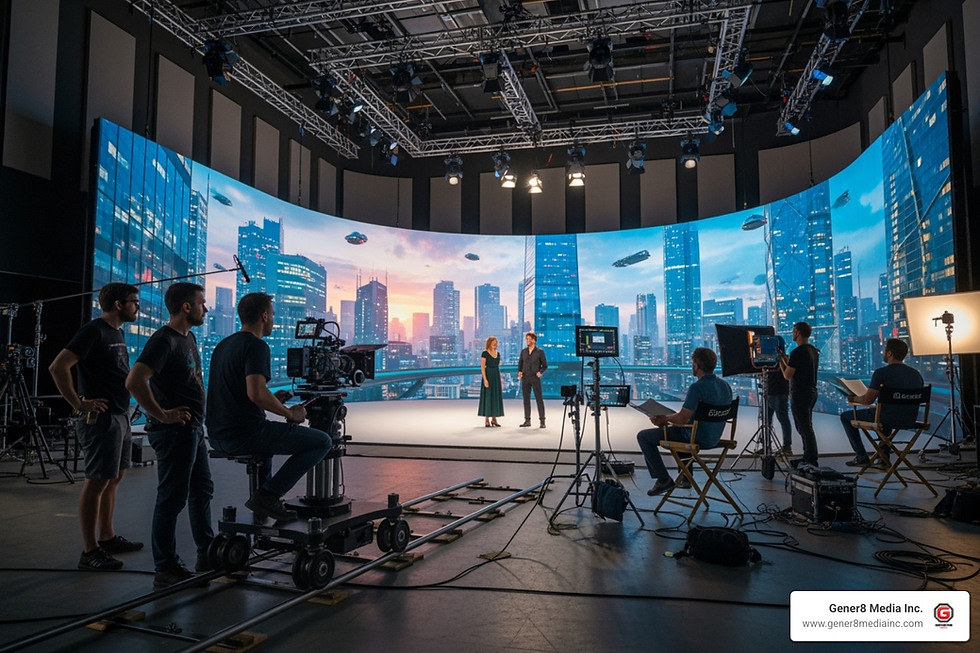
For filmmakers embracing the future, LED walls are game-changers. These massive, high-resolution displays show digital environments that respond in real-time to camera movements. Actors can perform in front of dynamic virtual sets that look completely real on camera. If you're curious about this cutting-edge approach, our LED Wall Consultation can help you explore the possibilities.
Creating these complex worlds demands serious computing power. That's where cloud computing steps in, providing the muscle needed to render detailed 3D assets without melting your local hardware. It's like having a supercomputer on tap whenever you need it.
Finally, haptic feedback adds that crucial sense of touch. From controllers that vibrate when you fire a virtual weapon to full-body suits that let you feel textures, haptics make digital interactions feel surprisingly real.
The Role of AI in Immersive Content Creation
Artificial Intelligence isn't just changing immersive content creation - it's revolutionizing it. We're watching AI become our creative partner, speeding up workflows and opening up possibilities we never imagined.
Generative AI is perhaps the biggest game-changer for asset creation. Instead of spending weeks modeling every tree, building, or character by hand, AI can generate detailed 3D models from simple text prompts or photographs. It's like having an incredibly fast artist who never gets tired.
Even more exciting are tools that transform rough sketches into 3D models. You can literally draw an idea on paper and watch AI turn it into a digital asset. Companies like Wacom and AWS are pioneering these AI-powered workflows, showing just how much creative potential we're open uping.
AI also enables personalized experiences that adapt to each user. Imagine an immersive story that changes based on your interests, or a training simulation that adjusts difficulty based on your performance. AI analyzes user behavior in real-time to create truly custom experiences.
Behind the scenes, AI-driven analytics help us understand how people interact with immersive content. This data reveals what works, what doesn't, and where users get stuck - invaluable insights for creating better experiences.
Perhaps most practically, AI handles workflow automation for repetitive tasks like texture generation and animation rigging. This frees up our artists to focus on the creative decisions that really matter, making production faster and more cost-effective.
Future Trends on the Horizon
The future of immersive content creation is arriving faster than most people realize, and it's absolutely thrilling. We're moving toward experiences that will make today's VR feel like early television.
Interactive storytelling is evolving beyond simple choose-your-own-adventure formats. Future immersive content will offer deeply branching narratives where your choices have real consequences, blurring the lines between movies and games in the best possible way.
Collaborative platforms are changing immersive experiences from solitary activities into shared adventures. Soon, you'll attend virtual concerts with friends, collaborate on 3D designs with colleagues across the globe, or simply hang out in digital spaces that feel as natural as your living room.
The next frontier is multi-sensory experiences that engage all your senses. Advanced haptics will let you feel virtual textures, while scent dispensers and temperature controls create truly holistic environments. We're already integrating some of these elements into our immersive studio solutions.
Advanced haptics will move far beyond simple controller vibrations. Imagine feeling the rough bark of a virtual tree or the resistance of opening a digital door. This level of tactile feedback will make immersive experiences incredibly realistic.
Volumetric video captures real-world performances in full 3D, allowing you to walk around recorded people and objects as if they were actually there. It's perfect for preserving performances or creating more lifelike digital humans than traditional 3D modeling allows.
These aren't distant dreams - they're technologies we're actively exploring and implementing today. The future of immersive content is being built right now, and we're excited to be part of shaping it.
Crafting Compelling Worlds: Strategies for Immersive Content Creation
Picture this: you put on a VR headset and suddenly you're standing on the deck of a pirate ship, feeling the ocean spray and hearing the creak of wooden planks beneath your feet. That magical moment when reality melts away? That's what we're after when we talk about immersive content creation.

At Gener8 Media, we've learned that creating truly captivating immersive experiences isn't just about having the fanciest equipment. It's about understanding the delicate dance between user participation, sensory engagement, narrative design, and yes, managing the technical complexity while keeping ethical considerations front and center.
The secret sauce? It all starts with treating your audience not as passive viewers, but as active explorers in a world you've carefully crafted just for them.
Key Strategies for Engaging Immersive Content Creation
When we sit down to design an immersive experience, we follow four core principles that have never let us down:
Tell a Story that matters. Every great immersive experience has a beating heart - its narrative. Whether you're guiding someone through a virtual museum or training them for a high-stakes medical procedure, your story provides the emotional anchor that keeps users invested. We've found that even the most technical training simulations become more effective when wrapped in a compelling narrative framework.
Engage All Senses whenever possible. Stunning visuals grab attention, but it's the spatial audio that makes footsteps echo authentically down a virtual hallway. It's the haptic feedback that lets users feel the texture of ancient stone walls. When you layer these sensory details thoughtfully, you create what we call "presence" - that magical feeling where users forget they're in a digital world.
Invite Participation at every turn. The beauty of immersive content lies in user agency - giving people the power to shape their experience. Maybe they choose which path to explore in your virtual environment, or perhaps they solve puzzles that open up new story elements. This participation transforms spectators into active participants, creating deeper emotional connections.
Layer in Details that reward curiosity. The difference between a good immersive experience and a great one often lies in the subtle touches. Hidden audio cues that tell backstories. Environmental details that change based on user actions. These elements of world-building make your digital space feel lived-in and authentic.
If you're ready to dive deeper into bringing these principles to life, our Virtual Production Training offers hands-on experience with the tools and techniques that make it all possible.
The Central Role of Storytelling
Here's something that might surprise you: in a medium where users can wander freely and interact with anything, storytelling becomes more important, not less. Think about it - when someone can go anywhere and do anything in your virtual world, a strong narrative structure becomes their North Star.
We approach immersive storytelling differently than traditional media. Environmental storytelling lets the world itself whisper secrets to curious explorers. A dusty photograph on a virtual desk tells a story without a single word of dialogue. Scorch marks on a wall hint at past events that users can piece together themselves.
Character development takes on new dimensions when users might embody those characters or stand face-to-face with them in virtual space. We've seen training simulations become dramatically more effective when learners connect emotionally with the virtual patients or colleagues they're helping.
The real magic happens with user-driven narratives. When someone's choices genuinely change the story's direction, they're not just consuming content - they're co-creating it. This level of personalization creates experiences that stick with people long after they remove the headset.
Most importantly, compelling storytelling helps achieve what we call "creating presence" - that moment when users stop thinking about the technology and start living in the story. That's when real learning, real emotion, and real change happen.
Overcoming Common Challenges
Let's be honest - immersive content creation isn't always smooth sailing. We've steerd these waters long enough to know where the rocks are hidden.
Cost and budget concerns keep many organizations on the sidelines. Yes, creating high-quality immersive experiences requires investment in specialized skills and technology. But here's what we've learned: start with clear goals and build strategically. A well-designed 360° video experience can deliver powerful results at a fraction of the cost of a full VR world.
Technical complexity can feel overwhelming, especially when you're juggling 3D modeling, game engines, motion tracking, and hardware optimization all at once. That's why we believe in building strong partnerships with technical experts who can handle the heavy lifting while you focus on the creative vision.
Motion sickness is the party crasher nobody wants to talk about. Poor design choices can leave users feeling queasy and reluctant to try VR again. We've learned that smooth movement systems, comfort settings, and careful attention to frame rates can prevent most issues before they start.
Data privacy and security deserve serious attention. Immersive experiences can collect incredibly detailed information about users - from eye movements to physical reactions. Building trust means being transparent about what data you collect and how you protect it.
Content distribution remains a puzzle we're all still solving. Getting immersive content to your audience shouldn't require a computer science degree. We focus on solutions that work across multiple platforms and devices, meeting users where they are rather than forcing them to adapt to our technology.
Want to stay ahead of these challenges? We regularly share hard-won insights and practical solutions on our blog, covering everything from technical tips to creative breakthroughs.
The bottom line? Every challenge in immersive content creation is solvable with the right approach, the right team, and a healthy dose of creative problem-solving.
Why Go Immersive? Unpacking the Benefits and Applications
Picture this: a medical student performs their first virtual surgery, making mistakes without consequences. A real estate client tours their dream home from thousands of miles away. A trainee practices high-risk procedures in complete safety. This is the power of immersive content creation in action.

The benefits of immersive experiences go far beyond the "wow factor." They deliver measurable results that traditional media simply can't match. Increased retention rates jump by up to 80% when learners actively participate rather than passively consume content. Information sticks because users experience it firsthand.
Improved engagement tells a similar story. Immersive content drives twice the interaction of static formats. Users spend more time exploring, touching, and connecting with your message. This deeper engagement translates directly into brand loyalty as audiences become part of your story rather than just observers.
The data insights are equally compelling. Immersive platforms capture rich information about user behavior - where they look, what they interact with, how long they engage. This treasure trove of data-driven insights helps refine future content and personalize experiences.
Perhaps most importantly, immersive technology creates safe training environments. High-stakes industries can simulate dangerous scenarios without real-world risks. Mistakes become learning opportunities rather than costly errors.
Applications Across Industries
The versatility of immersive content creation means it's changing how we work, learn, and play across virtually every sector.
Education and Training leads the charge with virtual field trips transporting students to ancient civilizations and medical simulations placing learners in operating rooms. Students can dissect virtual cadavers, practice complex procedures, and explore microscopic worlds - all without leaving the classroom.
Healthcare extends far beyond training. VR helps manage chronic pain, provides exposure therapy for phobias, and makes complex medical procedures understandable for patients. Imagine explaining a heart surgery by letting patients experience it virtually rather than through confusing diagrams.
Entertainment and Gaming remains the most visible application, but it's evolved beyond simple games. Interactive films let viewers influence storylines, while AR experiences bring digital characters into your living room. The line between passive entertainment and active participation continues to blur.
Real Estate and Architecture has acceptd virtual tours with enthusiasm. Potential buyers explore properties from anywhere in the world, while architects walk clients through buildings that exist only as blueprints. Our work in Real Estate Media regularly uses these techniques to help clients make informed decisions before breaking ground.
Retail is revolutionizing the shopping experience through virtual try-ons and product visualization. Customers see how furniture fits their space or test drive cars without visiting showrooms. This reduces returns and increases satisfaction by setting accurate expectations.
Marketing campaigns now create unforgettable brand experiences rather than just advertisements. Companies launch products in virtual worlds, tell stories through interactive experiences, and build emotional connections that traditional ads can't achieve. The result? Shorter sales cycles and stronger customer relationships.
The question isn't whether your industry can benefit from immersive content - it's how quickly you can start exploring its potential.
Frequently Asked Questions about Immersive Content
Creating immersive content creation can feel overwhelming at first, but it doesn't have to be. We've helped countless clients steer this exciting landscape, and these are the questions that come up most often in our conversations.
What skills are needed to create immersive content?
The beauty of immersive content creation lies in how it brings together creative storytelling and technical expertise. You'll need a mix of both worlds to succeed.
On the creative side, strong storytelling abilities are essential. After all, the most advanced technology means nothing without a compelling narrative to drive it. You'll also want solid skills in narrative design and understanding how stories work differently in interactive environments.
The technical skills are equally important. 3D modeling and animation using software like Maya or Blender helps you create the digital assets that populate your worlds. Game engine development in platforms like Unreal Engine or Unity is crucial for building interactive environments and programming the logic that makes everything work smoothly.
UX/UI design for spatial environments is a specialized skill - designing interfaces in 3D space is completely different from traditional 2D screens. You need to understand how people naturally move and interact in virtual spaces.
Don't forget about sound design. High-quality spatial audio can make or break an immersive experience. When users hear footsteps behind them or music that seems to come from a specific direction, that's what sells the illusion.
Finally, project management skills are vital. These projects often involve teams with diverse expertise, and keeping everyone coordinated requires strong organizational abilities.
How can businesses get started with creating immersive content?
Starting your immersive content creation journey doesn't require jumping into the deep end immediately. We always recommend a thoughtful, step-by-step approach.
Start by defining a clear goal. What do you want to achieve? Are you looking to train employees more effectively? Showcase products in a new way? Create memorable marketing experiences? Having a specific objective helps guide every decision that follows.
Next, research the different types of immersive content to see what fits your objective and budget. VR might be perfect for training simulations, while AR could be ideal for product visualization. 360-degree video often provides an excellent entry point - it's more accessible than full VR but still delivers impressive results.
You can start small with pilot projects. Consider creating an interactive product demo or a virtual tour of your facilities. These smaller projects let you test the waters, gather feedback, and build internal expertise before tackling larger initiatives.
For businesses ready to dive deeper, partnering with a specialized production studio like us often makes the most sense. We bring the technical expertise and creative vision to transform your ideas into compelling immersive realities, while you focus on your core business objectives.
What makes an experience truly "immersive"?
True immersion happens when users feel genuinely "present" in a digital environment - when they forget they're wearing a headset or looking at a screen and start believing they're actually there. This magical moment of suspended disbelief is what we're always working toward.
Engaging multiple senses is fundamental. High-resolution visuals and realistic spatial audio work together to create a convincing sensory experience. The more senses you can engage - sight, sound, and sometimes touch through haptic feedback - the more believable the world becomes.
User agency and interactivity are equally crucial. When users can make meaningful choices, manipulate objects, or influence the narrative, they become active participants rather than passive observers. This sense of control and consequence makes them feel truly invested in the experience.
The digital world must also feel believable and cohesive. Even if you're creating a fantastical environment, it needs consistent physics, lighting, and aesthetic. Those small details - the way shadows fall, how objects respond to touch, background ambient sounds - all work together to maintain the illusion.
Finally, a compelling narrative provides the emotional foundation that transforms a technical demo into a memorable experience. Whether it's an explicit story or environmental storytelling that unfolds through exploration, giving users a reason to care about what they're experiencing makes all the difference.
When these elements come together successfully, users often report feeling like they've truly "been somewhere" - and that's when you know you've created something special.
Conclusion
The landscape of digital storytelling is changing before our eyes, and immersive content creation sits at the heart of this revolution. We're not just witnessing a technological upgrade – we're experiencing a fundamental shift in how audiences connect with content and how brands tell their stories.
Think about it: we've moved from passive viewing to active participation, from flat screens to three-dimensional worlds, from telling stories to creating lived experiences. The spectrum we've explored – VR's complete digital immersion, AR's reality-enhancing overlays, MR's seamless blending of worlds, and 360-degree video's panoramic storytelling – represents just the beginning of what's possible.
The numbers speak for themselves. When retention rates jump by 80% and engagement doubles, we're not talking about incremental improvements. We're talking about a complete reimagining of what effective communication looks like. Whether you're training medical students through risk-free surgical simulations or helping real estate clients walk through their dream home from thousands of miles away, immersive experiences create connections that traditional media simply can't match.
The challenges are real. Budget considerations, technical complexity, and the learning curve can feel overwhelming. But here's what we've learned at Gener8 Media: the most powerful immersive experiences don't necessarily require the most advanced technology. They require thoughtful storytelling, genuine understanding of your audience, and the courage to let users become active participants in your narrative.
The technological convergence we're witnessing – AI streamlining asset creation, cloud computing democratizing access to powerful tools, and haptic feedback engaging our sense of touch – is making immersive content more accessible than ever. What once required massive studios and budgets is increasingly within reach of forward-thinking organizations ready to accept this creative potential.
At Gener8 Media, we've seen how immersive content creation reshapes audience interaction. From our virtual production work to complex 3D animations, we've watched clients find new ways to captivate their audiences and achieve their goals. The future of content isn't coming – it's here, and it's more exciting than we ever imagined.
Ready to step into this new world? Whether you're considering your first 360-degree video or dreaming of a fully immersive VR experience, the journey starts with a single step. Lift your next project with immersive documentary production and find how your vision can become an unforgettable reality.
The question isn't whether immersive content will reshape your industry. It's whether you'll be leading that change or watching it happen from the sidelines.


Comments