
The Best Virtual Production Studios for Your Next Project

Why Virtual Production Studios Are Changing Filmmaking Forever
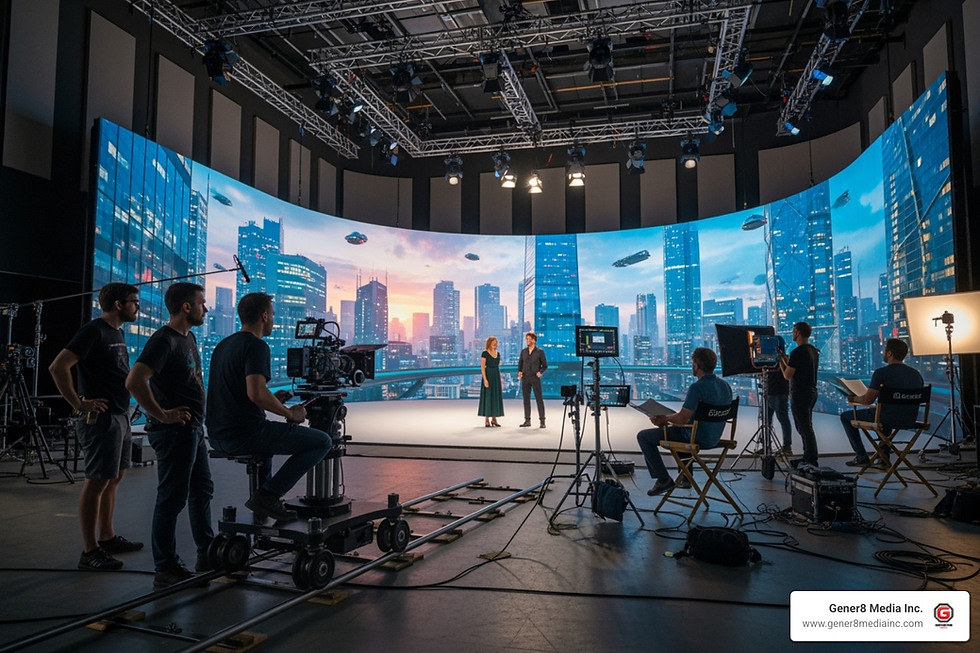
Virtual production studio technology is revolutionizing how films, commercials, and content are created. If you're looking for a virtual production studio, here's what you need to know:
Top Virtual Production Studio Features to Look For:
LED Volume Size: Minimum 24x12 feet, with larger studios offering up to 650 square meters
Pixel Pitch: 2.6mm or lower for sharp, high-resolution backgrounds
Camera Tracking: Mo-Sys StarTracker or equivalent for real-time movement sync
Software: Unreal Engine 5 for photorealistic virtual environments
Support Team: On-site VFX supervisors and Unreal Engine artists
HDR Capability: Wide color gamut (97%+ DCI-P3) and high brightness (1,500 cd/m²+)
The virtual production market is exploding. It's projected to grow from $2.1 billion in 2022 to $11.1 billion by 2027—a staggering 39.1% annual growth rate.
Traditional filmmaking meant traveling to locations, building expensive sets, and hoping the weather cooperated. Virtual production changes everything. It combines massive LED walls, real-time rendering engines like Unreal Engine, and precise camera tracking to create photorealistic environments that exist only digitally.
The results speak for themselves: productions can reduce costs by up to 30% and cut carbon emissions by up to 90% by eliminating travel and physical set construction. Actors see their surroundings in real-time instead of imagining green screens. Directors get immediate feedback. And lighting naturally reflects off virtual environments, creating in-camera visual effects that would traditionally require months of post-production work.
Whether you're shooting a sci-fi epic, a car commercial, or a corporate presentation, understanding how to choose the right virtual production studio is crucial for your project's success.
What is a Virtual Production Studio and How Does It Work?
Imagine walking onto a soundstage surrounded not by green screens, but by massive LED walls displaying a photorealistic alien landscape. The environment shifts in perfect perspective as the camera moves, and the light from the digital world illuminates the actors. That's a virtual production studio.
This technology solves the core problems of traditional filmmaking. Instead of traveling to expensive locations or shooting against a green screen and fixing it in post-production, virtual production brings the digital world onto the set.
Actors can see and react to their environment, and the lighting interacts naturally with them, creating authentic reflections and shadows in-camera. This shift is why the virtual production market is growing so rapidly, moving from a niche technology to the future of filmmaking.
But how does it work? It relies on a core technology stack working in perfect sync.
The Core Technology Stack
Every virtual production studio combines three essential technologies:
First is the LED wall (or LED volume). These are massive, high-resolution displays engineered for cinema cameras. Key specifications include a fine pixel pitch (2.6mm or less) for sharp images, high brightness (1,500 cd/m² or more) to compete with stage lighting, and a wide color gamut (over 97% of DCI-P3) for rich, accurate colors.
HDR capability provides the contrast and color range needed for true immersion. The size and shape of the volume, from curved walls to full cylinders, give filmmakers creative freedom.
The second piece is camera tracking. Systems like the Mo-Sys StarTracker track the camera's precise position in 3D space. This data is sent to the rendering engine, ensuring the digital background's perspective perfectly matches the camera's view. Without this, the illusion would break.
Finally, the real-time rendering engine acts as the brain. Unreal Engine is the industry standard, rendering incredibly detailed 3D environments, lighting, and effects in milliseconds. This real-time compositing means the shot you see on set is essentially the final shot, allowing for immediate creative decisions.
Want to see how we create these digital worlds? Check out our work in 3D Animations.
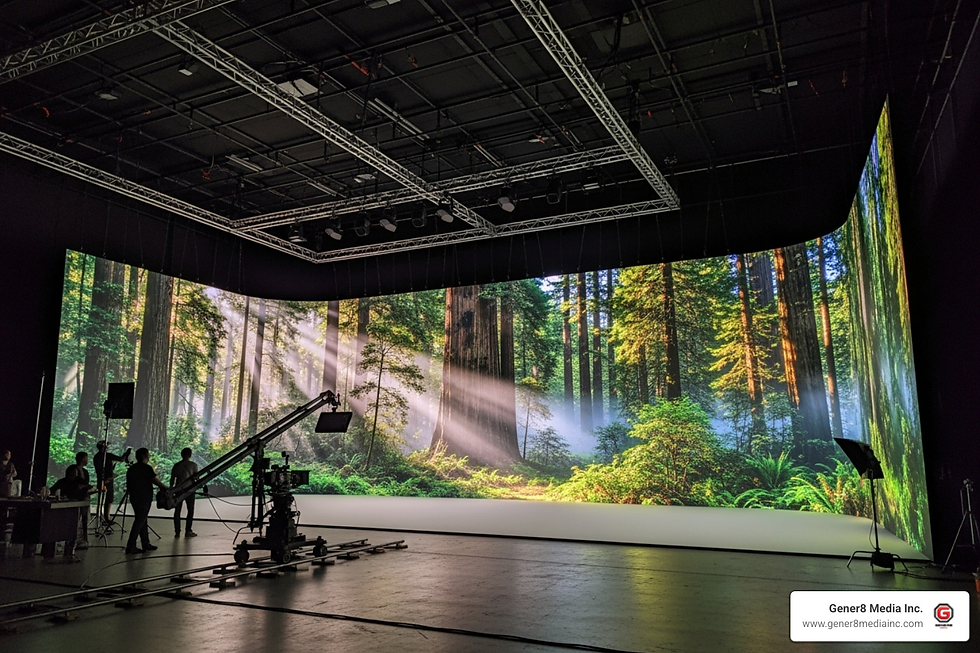
From Pre-Production to Final Pixel
Virtual production flips the traditional workflow by moving most visual effects work from post-production into pre-production and the shoot itself.
Pre-visualization becomes critical. Before shooting, we build and refine the virtual environments, allowing us to scout digital locations, block scenes, and plan camera angles. This upfront planning saves enormous time and money, ensuring the creative vision is locked in before the cameras roll. Learn more in our guide to Pre-visualization Animation.
On set, directors see the final shot with all virtual elements in place. Adjustments to lighting or the environment happen in real-time. This on-set collaboration between the director, cinematographer, and VFX supervisor, fueled by real-time feedback, fosters a creative freedom impossible with green screens.
For actors, the experience is transformative. Immersed in the actual environment on the LED walls, they deliver more genuine and natural performances. The result is reduced post-production through in-camera effects, leading to faster, higher-quality, and more budget-friendly productions.
The Key Benefits of Using Virtual Production
Using a virtual production studio isn't just about new technology; it's a fundamental shift that provides tangible benefits to your budget, creative vision, and environmental impact.
How Virtual Production Saves Time and Money
Filmmaking is expensive, but a virtual production studio offers significant savings. Imagine shooting scenes set in Tokyo and Iceland on the same day without leaving the studio. The reduced travel costs—no flights, hotels, or international per diems—are immense. You also eliminate expensive location fees and permits.
Furthermore, the need for fewer physical set constructions drastically cuts material and labor costs. Digital environments can be stored and reused, unlike physical sets that are built and demolished. This leads to a remarkably faster turnaround, as real-time creative decisions on set prevent costly reshoots and long post-production cycles.
Finally, weather independence means no more costly delays due to rain or bad light. The weather is perfect for every take, every time. These efficiencies can lead to substantial savings on overall production costs.
Opening up Creative and Sustainable Filmmaking
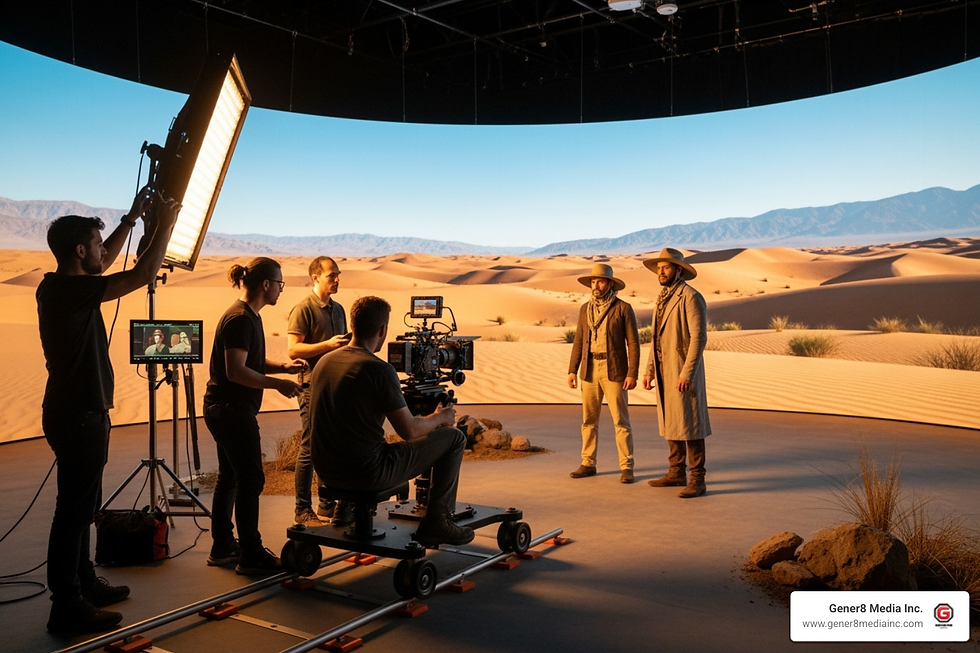
Beyond the financial advantages, a virtual production studio open ups creative possibilities while promoting sustainability. Your imagination is the only boundary, allowing for limitless locations from Mars to a medieval castle, all switchable in minutes. This gives even smaller-budget projects the scope of a blockbuster.
Cinematographers gain unprecedented lighting control. The perfect "golden hour" can last all day, ensuring visual consistency and the exact mood required for every scene. For actors, being surrounded by immersive environments on the LED walls leads to more natural and authentic performances. They can react to their surroundings, not a blank green wall.
This approach is also a major step forward in sustainability. Digital sets produce zero physical waste. By eliminating most location travel, virtual production can drastically reduce a project's carbon footprint. It's a method that improves creative vision and environmental responsibility simultaneously.
Find how we harness these capabilities in our work with Visual Effects Animation, and explore the stories we've brought to life in our Films. For a deeper understanding of our approach to professional content creation, check out our Professional Video Services.
How to Choose the Right Virtual Production Studio for Your Project
Choosing the right virtual production studio is about finding a partner whose technology and expertise align with your project's goals. Whether you're shooting a sci-fi epic, a car commercial, or a corporate presentation, the right studio is crucial for success.
Start by assessing your project's needs: the environments, camera movements, and budget. Then, dive into the technical specifications, but the team operating the technology is just as important. Check their portfolio, consider the studio's accessibility, and ensure their workflow is a good fit for your team.
If you need guidance, our Professional Video Services can help you steer the process.
Evaluating the Technology in a virtual production studio
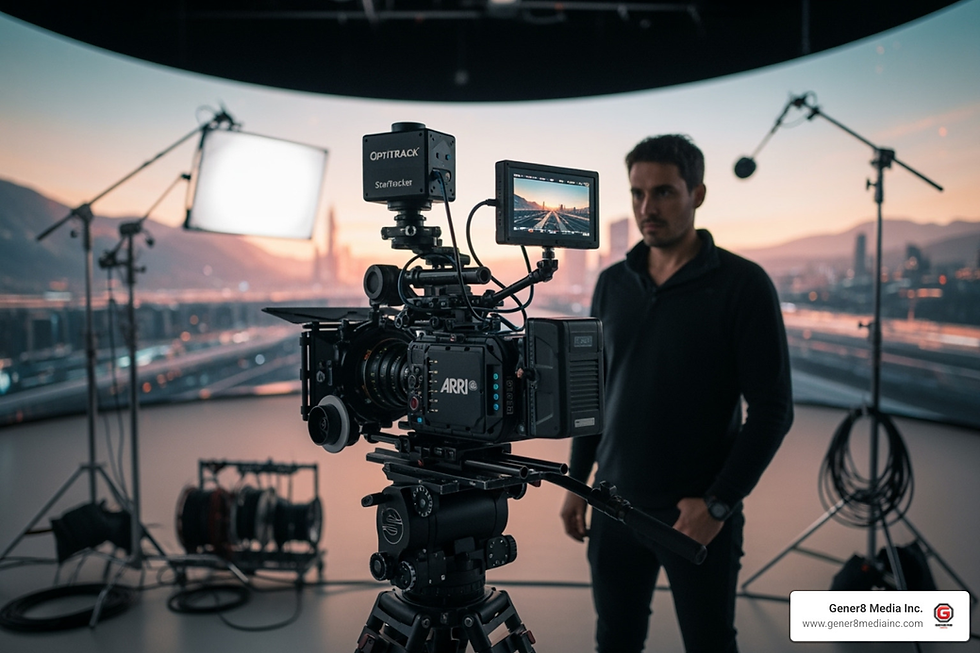
The technical specs of a virtual production studio directly impact your final product. A large LED volume size and shape, especially a curved wall, provides more creative freedom and immersion. The pixel pitch should be 2.6mm or smaller to ensure backgrounds look sharp and realistic, even in close-ups. HDR capability is essential for cinematic color and contrast.
The studio should also offer high-end camera and lens packages (like RED or Sony VENICE cameras) designed for virtual production. Finally, a highly accurate motion tracking system (such as Mo-Sys StarTracker) and powerful software (like Unreal Engine) are non-negotiable for creating a seamless illusion.
Assessing the Team and Support
Technology is only as good as the people operating it. A great virtual production studio has a skilled team to support your vision. Look for experienced on-site technicians and engineers who can manage the complex hardware.
VFX supervisors and Unreal Engine artists are crucial creative partners who can optimize assets and make real-time adjustments on set. Good production support, including project management, can streamline the entire process. The best studios foster a collaborative workflow, acting as true partners in bringing your vision to life.
If your team is new to this technology, we offer comprehensive Virtual Production Training to get everyone up to speed.
Diverse Applications for a virtual production studio
The versatility of a virtual production studio is one of its greatest strengths. It's no longer just for big-budget movies. Key applications include:
Film and TV series: Creating sci-fi, fantasy, or historical worlds without leaving the studio.
Commercials: Showing products, especially cars, in any environment imaginable with complete control.
Corporate events and product launches: Changing presentations into visually spectacular experiences.
Music videos: Building fantastical, rapidly changing environments that would otherwise be impossible.
Live broadcasts: Using virtual sets and augmented reality to create more engaging news and sports content.
Our expertise in Character Animation Studio work allows us to seamlessly integrate animated characters into these virtual worlds, opening up even more creative possibilities.
The Future of Content Creation and Emerging Trends
The virtual production studio landscape is sprinting forward, driven by powerful new tools and trends.
Unreal Engine 5 (UE5) has become a creative superpower for filmmakers, with features like Nanite for ultra-detailed models and Lumen for dynamic, natural lighting. The level of photorealism now achievable is staggering. You can Learn about Unreal Engine's role in filmmaking to see its full potential.
Other key trends are reshaping the industry. AI in asset creation is accelerating workflows by helping generate 3D models and textures, freeing artists to focus on creative storytelling.
Real-time ray tracing is becoming standard, delivering physically accurate light, shadows, and reflections instantaneously. We're also seeing marker-less tracking systems, which simplify setup and give camera operators more freedom.
Perhaps most importantly, the rise of smaller, more accessible studios is democratizing the technology. Virtual production is no longer confined to Hollywood, allowing more creators to tap into its power.
This is leading to expanding use cases in corporate, educational, and interactive content, weaving these techniques into media types we are only beginning to imagine.
For creators interested in how these dynamic visuals come together, our work in Motion Graphics Animation showcases some of these emerging techniques in action.
Frequently Asked Questions about Virtual Production
We talk with creators every day who are curious about virtual production studio technology. Here are answers to the most common questions.
Is virtual production expensive?
The initial investment in a virtual production studio is significant, but it's crucial to compare it to the alternative. Traditional productions involve costs for travel, location fees, set construction, and extensive post-production. Virtual production changes this equation.
By eliminating travel and physical builds, the technology can save millions in set construction and location fees. The ROI comes from shooting faster, making creative decisions in real-time, and dramatically reducing post-production hours.
Productions can see a significant reduction in overall costs compared to traditional methods. Furthermore, the technology is becoming more scalable, with setups available for a range of budgets, not just blockbusters.
Can any project use a virtual production studio?
While incredibly versatile, virtual production is a tool best suited for specific situations. It truly shines for projects that require fantastical or hard-to-reach locations, making it ideal for sci-fi, fantasy, and period pieces.
Car commercials are another perfect fit, allowing vehicles to be placed in any environment with complete control over lighting and reflections. Projects with contained scenes or tight deadlines also benefit greatly from the efficiency and reduced post-production time.
However, there are limitations to consider. Some filmmakers feel that achieving perfect photorealism for certain everyday, documentary-style outdoor scenes can still be a challenge. For those specific scenarios, traditional location shooting might remain the better choice. For most controlled, stylized, or fantastical environments, however, virtual production is an immensely powerful tool.
How is virtual production different from a green screen?
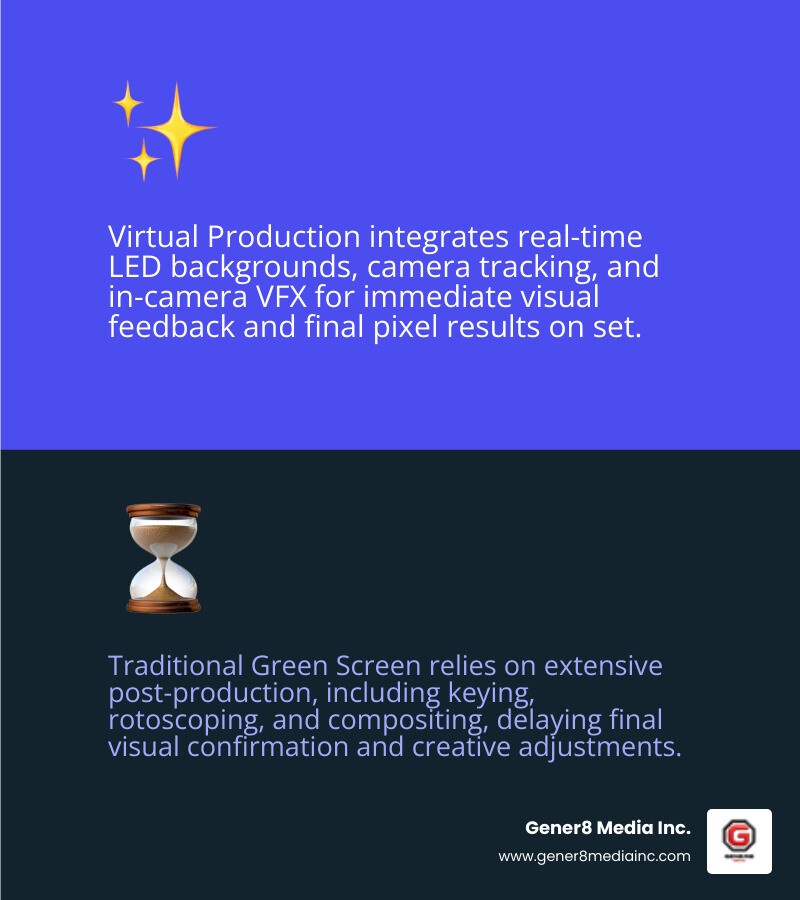
This question gets to the heart of the revolution. While both replace backgrounds, the experience and results are worlds apart.
The key difference is real-time reflections and lighting. An LED wall emits light that naturally reflects off actors and props, creating authentic highlights and shadows in-camera. A green screen is passive and requires all lighting interaction to be faked in post-production.
This leads to greater actor immersion. Instead of imagining their surroundings, actors see and react to the virtual world in real-time, leading to more authentic performances. Finally, virtual production enables in-camera final shots.
Directors see a near-final image on set, allowing for immediate creative adjustments and drastically reducing the post-production workload of keying, rotoscoping, and compositing required for green screen.
For more on how we approach the critical planning phase, check out our work in Pre-visualization Animation.
Conclusion
If there's one takeaway about the virtual production studio, it's this: it is fundamentally changing how stories get told. This technology offers the creative freedom to build any world imaginable in a controlled environment, allowing actors to interact with their surroundings in real-time for more authentic performances.
The practical benefits are just as compelling. Productions see significant cost savings and boosted production efficiency by reducing travel, eliminating location fees, and shortening post-production. It's also a more sustainable choice, with the potential to cut a project's carbon emissions dramatically. The technology—from LED walls to Unreal Engine—is only getting better and more accessible.
However, technology is only part of the equation. Choosing the right partner to guide you through this landscape is what makes a production truly exceptional.
At Gener8 Media Inc., based in Northern California, we specialize in changing diverse visions into immersive experiences.
We don't just provide equipment; we collaborate with you, bringing our expertise in film, TV, and digital content to ensure your project reaches its full potential. We are passionate about leveraging these advanced tools to help you tell stories that resonate and inspire.
Ready to explore what's possible? Contact us to start your documentary production, or learn more About Us and how we're pushing the boundaries of content creation.
The future of filmmaking is here. Let's create something remarkable together.


Comments