
Unlocking the Future: The Power of Architectural 3D Animation and VFX

Why Architectural 3D Animation is Changing Design and Marketing

Architectural 3D animation creates a short, computer-generated movie of a building or design. It transforms static blueprints into dynamic visual experiences, allowing viewers to virtually explore a space before it's built.
What is Architectural 3D Animation?
Definition: A sequence of rendered images creating a moving visualization of architectural designs
Key Difference from Static Renders: Adds time and movement for an immersive narrative journey, not just a single snapshot
Primary Purpose: To visualize and communicate architectural concepts with realism and emotional impact
Common Types: Fly-throughs, walk-throughs, fly-arounds, exploded views, and site integration videos
Typical Duration: 30 seconds to 3 minutes, depending on project scope
The architectural visualization market is experiencing explosive growth—valued at $1.5 billion in 2022 and projected to reach $4.2 billion by 2030. This surge isn't surprising. As one industry professional put it: "Imagine walking through a building that hasn't even been built yet. You move from room to room, feel the flow of the space, and appreciate the sunlight streaming through the windows."
This is the power of architectural animation: turning abstract concepts into tangible experiences. It helps architects find design flaws early, lets developers pre-sell properties, and allows clients to connect emotionally with a space before construction.
Video content dominates modern marketing, favored by Google and social media algorithms. While static images show highlights, animation creates an immersive exploration that captures attention and drives engagement far more effectively.
I'm Lucas Simmons, a content strategist and media producer with Gener8 Media Inc. I help brands use cutting-edge visual storytelling like Architectural 3D animation to turn complex ideas into compelling narratives. My work combines strategic content with advanced production, and I've seen how animation bridges the gap between vision and reality for architects, developers, and creative professionals.
What is Architectural 3D Animation and How Does It Lift Design?
At its core, architectural 3D animation brings unbuilt spaces to life through dynamic, computer-generated video. It is closely related to traditional 3D computer graphics, but with a focus on architectural forms and environments.
It is not just about showing what a building looks like, but what it feels like to be there—to move through its halls, experience the play of light, and understand its environmental context. This tool is indispensable for design, development, and real estate professionals.
Beyond Static Images: Animation vs. 3D Rendering
The distinction between a static 3D rendering and an architectural 3D animation is fundamental. A static rendering is a beautifully composed photograph of a future building, capturing a single moment and perspective. It is excellent for showcasing key features.
An animation, however, is like a feature film of the building. It adds time and movement, turning passive observation into an immersive exploration. While a static image hints at spatial flow, an animation shows it, guiding the viewer on a narrative journey.
As industry experts note, "Unlike static images that showcase buildings from advantageous angles, animation is a more meticulous work that helps reveal the true potential of a space without holding back defects." This dynamic approach reveals the design's true potential, providing a comprehensive understanding that still images can't match. It is about experiencing the space, not just seeing it.
To explore more about how we create these dynamic visuals, visit our page on 3D Animations.
The Power of Immersive Storytelling
Beyond visualization, architectural 3D animation excels at immersive storytelling. It adds depth, context, and emotion to your vision, making it a powerful tool for communicating complex ideas and captivating audiences. We craft narratives that highlight design elements, demonstrate function, and evoke the desired atmosphere.
Our goal is always to achieve photorealism, ensuring every detail comes alive with breathtaking accuracy. This detail, combined with expert sound design and cinematic camera work, creates an experience nearly indistinguishable from real life.
The quality and realism of architectural animations have indeed "increased exponentially in recent years, making them virtually indistinguishable from real life and a powerful marketing tool." This ability to deeply engage viewers makes architectural 3D animation a standout choice for conveying a truly compelling vision.
Learn more about how we use visual effects and animation to tell your story at Visual Effects & Animation.
Core Components of a High-Quality Animation
Creating a high-quality architectural 3D animation is a sophisticated process that relies on several key components:
Photorealism: The foundation is creating visuals so realistic they could be mistaken for photos or video, requiring meticulous modeling, texturing, and lighting.
Realistic Lighting: Crucial for mood, we accurately simulate how natural and artificial light interact with the building at any time of day or year.
Accurate Textures and Materials: Every surface—concrete, glass, wood—is rendered with precise textures to convey a tactile sense of the design.
Cinematic Camera Movement: Camera movement is vital for storytelling. We choreograph virtual cameras to guide the viewer, highlight features, and create an engaging experience.
Sound Design and Music: To improve emotional impact, we integrate music, ambient sound effects, and voiceovers for a truly immersive experience.
Post-Production and Visual Effects (VFX): In this final stage, we refine raw footage with color grading, motion graphics, and VFX to create a polished, professional animation.
The Transformative Benefits for Architects, Developers, and Clients
Architectural 3D animation is a strategic asset with tangible benefits at every project stage. It's a universal language that clarifies ideas, inspires confidence, and helps realize visions from concept to sale.
For Architects: Improved Design Analysis and Problem-Solving
For architects, architectural 3D animation is a vital tool for design analysis and problem-solving. Visualizing a design in motion helps identify issues and explore solutions in a realistic context before construction, saving significant time and money.
Imagine being able to:
Identify Design Flaws Early: Spot structural or spatial conflicts missed in static drawings.
Test Materials and Finishes: See how materials react to different lighting and integrate into the design.
Analyze Sun Studies: Understand how natural light interacts with the structure to optimize energy efficiency and atmosphere.
Validate Spatial Flow: Virtually walk through a space to confirm its function, accessibility, and user experience.
As one expert highlighted, "Architectural animations allow architects to analyze design concepts, identify potential issues, and explore solutions in a dynamic, realistic context." Furthermore, "changes identified in the animation stage can avoid costly alterations during construction." This ability to feel the layout and flow of a project before large financial investments are made is priceless.
While we focus on dynamic visuals, understanding the principles of good visual communication is key, as discussed in our Architectural Photography San Francisco guide.
For Developers: A Powerful Marketing and Sales Engine
In the competitive real estate market, architectural 3D animation is a game-changing marketing and sales engine. It allows developers to showcase unbuilt properties, attract investors, and engage buyers like never before. The statistics speak for themselves: "3D architectural animations... boosting sales and saving time by allowing potential buyers to tour a property virtually before it’s even built."
Consider these benefits:
Pre-Sell Properties: Offer virtual tours long before groundbreaking to secure early commitments from informed buyers.
Attract Investors: Present cinematic visions that clearly demonstrate project viability and potential returns.
Create Social Media Content: Short, shareable clips for platforms like Instagram and YouTube boost engagement and reach. "Google ranking and social media favor video content, making 3D animation a popular choice for marketing and presentations."
Achieve Higher ROI: Animations immerse the audience, leading to deeper emotional engagement and a better return on investment.
We specialize in leveraging these techniques to craft powerful narratives that drive results. Learn more about how we use animation for your campaigns at 3D Animation for Marketing and explore our broader real estate media offerings at Real Estate Media.
For Clients: Unparalleled Clarity and Confidence
For clients—homeowners, tenants, or stakeholders—architectural 3D animation offers unparalleled clarity and confidence. It bridges communication gaps by turning technical plans into an understandable and emotionally resonant experience.
This means:
Bridge Communication Gaps: Make complex concepts clear to non-technical stakeholders, ensuring everyone is on the same page.
Get Faster Design Approvals: Clients who can visualize the final product—including lighting, textures, and flow—provide quicker, more confident approvals. "It's much easier to approve a design when you’ve 'walked through' it!"
Foster Emotional Connection: A virtual walkthrough allows clients to connect with a space before it exists, improving engagement and satisfaction.
Visualize the Final Product: Seeing a future home or office in detail reduces uncertainty and builds excitement.
Reduce Uncertainty: A clear visual narrative alleviates anxieties common to large construction projects.
The clarity and confidence derived from these animations are invaluable. It's about empowering clients with the ability to truly see and feel their vision come to life. Our Real Estate Photography Northern California Guide also touches on the importance of clear visual communication for clients, a principle we extend to our animated offerings.
The Creative Process: From Blueprint to Cinematic Architectural 3D Animation

Creating a high-quality architectural 3D animation blends technical precision with artistic storytelling. It requires a clear vision, specialized software, and a collaborative workflow. Our streamlined, flexible process ensures your vision is realized accurately and beautifully.
The Typical Workflow of an Architectural 3D Animation Project
Our process is designed to be collaborative and transparent. The typical workflow involves these key steps:
Briefing & Conceptualization: We gather your project plans (CAD files, sketches) and design specs. We then discuss your goals, target audience, and desired narrative to define the project scope and understand your vision.
3D Modeling: Our team converts your 2D plans into detailed, architecturally accurate 3D models, outlining the structure's shape, dimensions, and features.
Texturing & Lighting: We apply realistic textures and materials to the models. We then set up natural and artificial lighting to create the desired mood and ambiance.
Camera Path Animation: We choreograph the virtual camera's movements (fly-throughs, walk-throughs) to guide the viewer through a compelling narrative, animating elements like opening doors or moving shadows.
Rendering: The computer renders each frame of the animation, a computationally intensive process that creates high-resolution images. We may use render farms to speed up this stage for complex projects.
Post-Production & VFX: We assemble the rendered frames and add final touches like color grading, motion graphics, music, and sound effects to polish the animation into a cinematic final product.
Essential Software and Technology
Producing high-quality architectural 3D animation requires powerful software and technology for realism, detail, and efficiency:
3D Modeling Software: Programs like Autodesk 3ds Max, Blender), and Revit are fundamental for creating accurate architectural models from CAD drawings and BIM data.
Powerful Rendering Engines: Engines like Corona Renderer, V-Ray, or Lumion generate photorealistic images by calculating light, reflections, and materials.
Post-Production Tools: Adobe After Effects and Premiere Pro are used for compositing, color correction, motion graphics, and final editing.
Real-time Visualization Platforms: Unreal Engine or Twinmotion are used for interactive experiences and rapid visualization, especially in early design phases.
Cloud Rendering: We use cloud render farms for large projects to reduce rendering times and meet tight deadlines without sacrificing quality.
Our expertise in these advanced tools ensures that every architectural 3D animation we produce is of the highest caliber. Learn more about the specific software and techniques we employ in our 3D Animation Services guide.
Exploring Different Types of Architectural Animations
The beauty of architectural 3D animation lies in its versatility. Different types of animations serve different purposes:
Fly-through Animations: A simulated camera journey (30-60 seconds) through a building's interior and exterior, showcasing the design's flow and experience.
Walk-through Animations: An eye-level view (60-90 seconds) that simulates walking through a space, effective for interior tours to show details and ambiance.
Fly-around Animations: An aerial view (20-40 seconds) showing the building's exterior and its context, ideal for demonstrating massing and environmental integration.
Exploded-view Animations: Technical animations (15-30 seconds) that deconstruct a building to show its internal structure, clarifying construction details for contractors.
Sequence-based Narrative Animations: These longer animations (90-180 seconds) combine multiple styles to tell a comprehensive story, effective for engaging investors.
Site Integration Animations: These animations insert a 3D model into drone footage of the actual site, showing how the project fits its real-world environment. We can show your future building in its future home!
Navigating Project Costs and Choosing the Right Studio
Understanding cost factors and how to choose a creative partner is crucial for a successful architectural 3D animation project. A quality animation yields significant returns by saving time, reducing errors, and increasing sales. We want to help you make an informed decision.
Key Factors Influencing the Cost of Architectural 3D Animation
The cost of an architectural 3D animation can vary widely. Several key factors contribute to the overall price:
Animation Length: Longer animations require more rendering time and effort, directly impacting the cost. Prices often scale with the duration and complexity.
Scene Complexity & Detail: Intricate architecture, multiple buildings, detailed landscaping, and specific interior elements increase the modeling and rendering workload, affecting the price.
Level of Realism: Photorealism is resource-intensive. Higher realism requires more time and processing power for texturing, lighting, and rendering.
Turnaround Time: Expedited projects incur higher costs. Standard turnarounds range from 1-2 weeks for short animations to several months for complex projects.
Number of Unique Scenes: Each unique scene (interior room, exterior view) adds to the modeling and animation effort.
Inclusion of 3D People or Simulations: Animated characters, dynamic water, realistic foliage, or traffic increase complexity and cost, as do detailed sun or energy simulations.
Design Stage: Animations from early-stage designs may require more modeling work than those based on finalized CAD files.
Storytelling Elements & VFX: Strong narratives, complex camera movements, or advanced VFX increase the cost.
Due to these variables, providing a one-size-fits-all price is impossible. We always recommend discussing your specific project needs to get an accurate, custom quote.
How to Choose the Right Architectural Animation Studio
Choosing the right studio is critical to your project's success. Here’s what to look for:
Portfolio Review: Examine their past work for the quality, realism, and storytelling you need. Look for projects similar in scope to yours.
Industry Expertise: A studio that understands architecture, construction, and real estate can better translate technical drawings into compelling visuals.
Clear Communication: A good studio communicates clearly at every stage, listens to your needs, and offers insights to avoid misunderstandings.
Defined Workflow: A transparent, organized workflow with clear stages for feedback and revisions ensures efficiency and lets you track progress.
Client Testimonials & Reputation: Positive testimonials indicate reliability, quality, and customer satisfaction.
Technical Capabilities: Ensure the studio uses cutting-edge software and hardware to deliver high-quality results efficiently.
Local Presence and Understanding: For Northern California projects, a local studio like Gener8 Media Inc. understands the regional context and market, offering a more responsive service.
As experts suggest, "Choosing a good 3D visualization studio can be the key difference between a design that is merely good and one that is truly great." We believe in aligning perfectly with your expectations and artistic direction. For a comprehensive guide on selecting a partner, see our 3D Animation Studio Complete Guide.
The Future of Architectural Visualization

Architectural visualization is a rapidly evolving field, constantly pushing the boundaries of realism and interactivity. Emerging technologies offer powerful new ways to experience unbuilt spaces, making the future of architectural 3D animation incredibly exciting.
Emerging Trends: Real-Time Rendering and Virtual Production
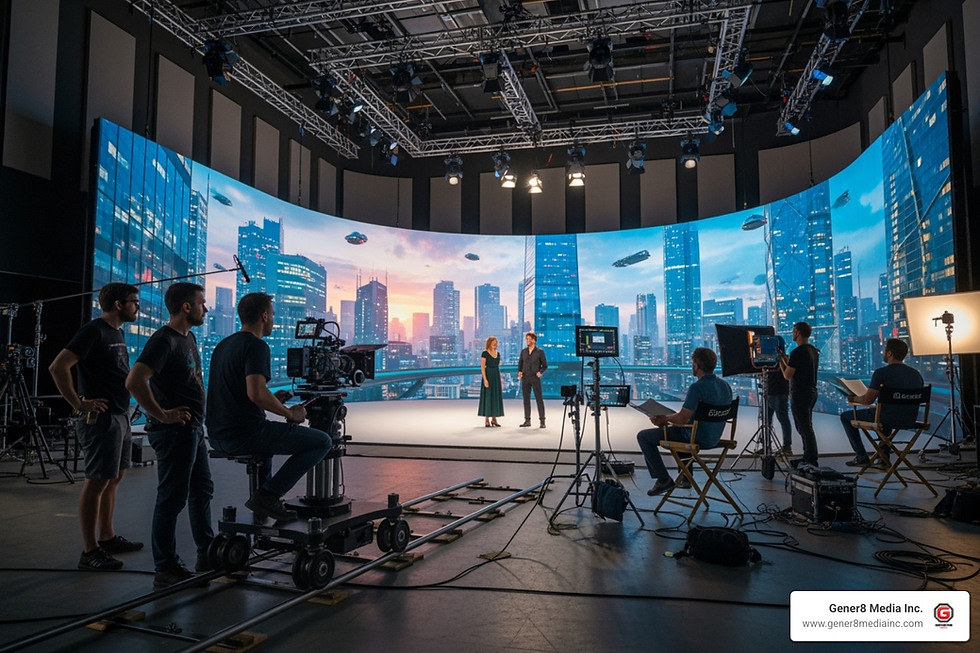
A key trend is the rise of real-time rendering and virtual production. Unlike traditional methods with long render times, real-time engines from the gaming industry generate photorealistic visuals instantly.
This innovation brings several advantages:
Interactive Experiences: Clients can explore a 3D model in real-time, making design changes on the fly and seeing immediate results, changing passive viewing into an active experience.
Real-time Feedback: Architects get instant visual feedback, accelerating the design process. Virtual production enables real-time collaboration across digital or physical environments.
Cinematic Quality at Speed: These engines produce cinematic-quality visuals in a fraction of the time, shortening production cycles.
This blend of gaming technology and architectural visualization is revolutionizing how we interact with and understand designs. Our work in 3D Animation for Games gives us a unique edge in applying these real-time principles to architectural projects.
The Rise of VR/AR in Architecture
Closely linked to real-time rendering is the growing use of Virtual Reality (VR) and Augmented Reality (AR) in architecture, which take immersion to a new level:
Immersive VR Walkthroughs: With a VR headset, clients can step inside a proposed building to experience its scale and spatial relationships as if they were there. These experiences are highly immersive and interactive.
Augmented Reality Overlays: AR overlays digital elements onto the real world. For example, you can view a finished building projected onto a construction site using a phone or tablet.
Improved Client Engagement: These interactive tools foster unparalleled engagement, allowing clients to intuitively explore and influence design decisions.
AI and Automation in 3D Animation
Looking ahead, Artificial Intelligence (AI) and automation are set to transform the architectural 3D animation pipeline. Potential applications include:
Streamlining Workflows: AI can automate repetitive tasks like generating textures, populating scenes, and optimizing render settings.
Automated Asset Creation: AI tools can generate complex 3D assets from simple prompts, speeding up the modeling phase.
Faster Rendering and Optimization: AI can predict optimal render settings, drastically reducing the time needed for high-quality frames.
Predictive Design Analysis: AI can analyze designs in real-time, offering insights and suggesting improvements based on large architectural databases.
These advancements promise to make architectural 3D animation even more accessible, efficient, and powerful, allowing us to focus more on the creative storytelling aspects that make each project unique.
Conclusion
Architectural 3D animation has fundamentally changed how we design, market, and experience architecture. It transforms abstract concepts into tangible, emotional journeys, providing clarity for clients, powerful tools for developers, and invaluable insights for architects.
By embracing this technology, you are not just showcasing a building; you are selling a vision and building the future. At Gener8 Media Inc., based here in Northern California, we specialize in leveraging cutting-edge animation and VFX to turn your architectural vision into an unforgettable cinematic experience.


Comments