
Lights, Camera, Action: The Journey of Documentary Filmmaking

The Power of Real Stories

Documentary film production is the art and craft of creating non-fiction films that capture real-life events, people, and issues to inform, inspire, and drive social change. At its core, documentary filmmaking involves three essential stages: pre-production (planning and research), production (filming), and post-production (editing and finishing).
Key components of documentary film production:
Pre-Production: Story development, research, scripting, budgeting, and legal preparations
Production: Filming interviews, capturing B-roll footage, recording audio, and managing shoots
Post-Production: Editing footage, sound design, color grading, and creating the final film
Distribution: Film festivals, streaming platforms, theatrical releases, and impact campaigns
Documentaries are non-fictional films that immerse viewers in real-life stories using techniques like interviews, archival footage, and observational filming. These powerful storytelling tools can foster awareness, provoke thought, and drive social change by offering audiences a lens to understand the world beyond their own experiences.
As one filmmaker put it: "Making documentaries is one of the most rewarding and challenging endeavors you can be involved in." The best documentaries don't just inform - they create empathy, challenge assumptions, and inspire action.
Whether you're exploring social justice issues, environmental challenges, or deeply personal stories, documentary filmmaking requires both technical expertise and a deep commitment to authentic storytelling. The journey from initial concept to final distribution involves careful planning, skilled execution, and a never-wavering focus on the human stories at the heart of every great documentary.
For more details on our approach to Documentaries, explore our dedicated page.
The Blueprint: Pre-Production and Story Development
Think of making a documentary like building a house – you wouldn't start without a solid blueprint. Documentary film production begins long before cameras roll in a crucial phase called pre-production. This is where an idea transforms into a concrete plan.

The heart of pre-production is finding a story you're passionate about. We look for stories with real people facing challenging goals – narratives with clear emotional stakes. Research is essential; we dig deep to understand every angle, identify potential interviewees, and gather facts. This isn't just collecting data; it's understanding the human complexities that make a story worth telling.
Even though documentaries capture real life, they benefit from structure. A two-column script (visuals on the left, audio on the right) helps organize the film's flow while remaining flexible enough to capture unexpected moments. Throughout this process, authenticity and integrity guide every decision. Our job is to find and amplify the narrative that already exists, not manufacture drama.
Finding and Developing a Compelling Story
How do you find stories that stick with audiences? Pay attention to the world around you. The best subjects often involve a unique character facing a significant challenge that resonates on a human level. Look for stories with inherent conflict, high stakes, and the potential for change.
Our research goes beyond Google, involving in-depth investigations, expert consultations, and time spent with the communities we're documenting. This builds trust and ensures our storytelling is accurate. When selecting interviewees, we look for people who can share their experiences authentically. The best subjects speak from the heart.
You can see examples of compelling narratives we've helped bring to life on our Films page.
Documentary Styles and Approaches
Documentaries have distinct styles. Understanding these helps us choose the best framework for the narrative.
Observational documentaries act like a fly on the wall, capturing reality as it unfolds with minimal filmmaker intervention.
Expository documentaries use narration and interviews to guide viewers through complex topics.
Participatory documentaries acknowledge the filmmaker's presence, making them part of the story.
Other styles include reflexive, poetic, and performative documentaries, each offering a unique lens on reality.
Here's how these different styles compare in practice:
Style | Key Features | Our Approach |
Observational | Minimal filmmaker intervention, "fly on the wall," direct cinema, emphasis on real-time events | We let subjects' actions and words speak for themselves, capturing those unscripted moments that reveal deeper truths |
Expository | Voice-over narration, interviews, archival footage, persuasive argument, clear message | We use this approach to provide context and guide audiences through complex topics with expert insights |
Participatory | Filmmaker interacts with subjects, acknowledged presence, often includes filmmaker's journey | We engage with subjects to build trust and reveal deeper truths, being transparent about our role in the storytelling |
Financial Aspects of Documentary Film Production
Passion projects still need funding. The financial side of documentary film production requires meticulous budgeting for equipment, travel, crew, post-production, insurance, and legal fees.
Funding sources are diverse. Grants from organizations like the Sundance Institute Documentary Fund are a primary source for independent films. Crowdfunding platforms build an audience while raising funds, and private investors may support projects that align with their values. Securing funding requires a compelling pitch deck and proposal that outlines your story, its feasibility, and its potential impact.
Legal and Ethical Considerations
Navigating the legal and ethical landscape is critical. Copyright and fair use must be addressed for any existing music, photos, or archival footage. Understanding Creative Commons licenses can provide affordable content options.
Talent releases and location permits are essential legal protections. Every person appearing in your film should sign a release. Our commitment is to represent truth, not manipulate it. We build relationships with subjects based on trust, obtaining informed consent and protecting the dignity of those who share their lives with us, especially when dealing with sensitive topics.
Capturing Reality: The Production Phase
The production phase in documentary film production is where careful planning meets the beautiful chaos of real life. It's an exciting, unpredictable stage where we capture the raw materials for the film.

Our shooting process revolves around achieving comprehensive coverage while staying flexible. This means conducting thoughtful interviews, capturing plenty of B-roll footage for context, and being present for spontaneous emotional moments. Capturing emotion is a delicate task, requiring technical proficiency and sensitivity to our subjects' experiences.
Professional set etiquette and strong team collaboration are crucial for creating an environment where authentic stories can emerge. Documentaries rarely go according to plan, so problem-solving on set is a daily occurrence. The best crews adapt quickly while keeping their eyes on the story's bigger picture.
Essential Crew Roles and Responsibilities
A documentary crew is a well-orchestrated team where each member has a specific, vital role.
The Director is the creative visionary, guiding the film's artistic and dramatic aspects and ensuring every shot serves the story.
The Producer is the organizational backbone, managing the budget, schedule, and logistics. The Sundance Institute offers a Documentary Producers Track to support this vital role.
The Cinematographer (Director of Photography) is responsible for the film's visual aesthetic, operating the camera and managing lighting. This specialized role commands an average salary of $63,230.
The Sound Recordist ensures clean audio, managing microphones and mixers to capture clear dialogue and ambient sound.
The Production Assistant is the unsung hero, handling administrative duties and assisting on set to ensure everything runs smoothly.
Understanding these roles is key to an efficient production. You can find detailed Production Role Descriptions to learn more.
Key Steps in Documentary Film Production: Shooting and Audio
In documentary shooting, precision and adaptability are our watchwords. Cinematography choices, like shot composition and framing, form the foundation of compelling visuals that connect with audiences.
Lighting interviews requires special attention. We often use three-point lighting (key, fill, and back lights) to sculpt subjects, but we're also skilled at using natural light to create authentic moods in real-world environments. A variety of shots—close-ups for intimacy, medium shots for interaction, and wide shots for context—keeps viewers engaged.
While high-end cameras like the Canon C300 offer incredible quality, the story always comes first. Powerful documentaries can be shot on smartphones with the right gear.
Audio quality is absolutely critical. Poor audio can ruin beautiful visuals. We use different microphone types for different purposes.
Lavalier mics (e.g., Rode Wireless) are excellent for clear dialogue, while shotgun mics (e.g., Audio-Technica AT875R) are great for capturing sound from a distance. Recording clean audio involves monitoring levels, minimizing background noise, and using wind protection outdoors. It's a technical aspect that, when done well, goes unnoticed but is glaring when done poorly.
Crafting the Narrative: Post-Production and Impact
Once filming is complete, post-production begins. This is where documentary film production transforms raw footage into a powerful, cohesive story. It's like sculpting: we carefully chip away at hours of material until the final narrative emerges.

The editing process shapes the narrative arc, creating a "roller coaster" of emotion that keeps audiences engaged. But it's more than just cutting footage. Music and sound design breathe life into every scene, while color grading establishes the right mood. Graphics and visual elements can clarify complex information and add artistic flair.
The Crucial Role of Editing
Editing is the heart of documentary film production. It's where scattered pieces of reality become a narrative that can change perspectives. We often start by transcribing interviews to create a "paper edit," mapping out the story before touching any software.
From there, we build a rough cut and then refine relentlessly, searching for the perfect narrative arc. What stays, what goes, and how scenes connect to create maximum emotional impact are the key questions. This flexibility to find unexpected connections and themes is what separates great documentaries from merely good ones. The careful sequencing of scenes builds tension and reveals truth, creating unforgettable moments in any genre, from environmental films to gripping True Crime Documentaries.
The Impact of Technology and AI
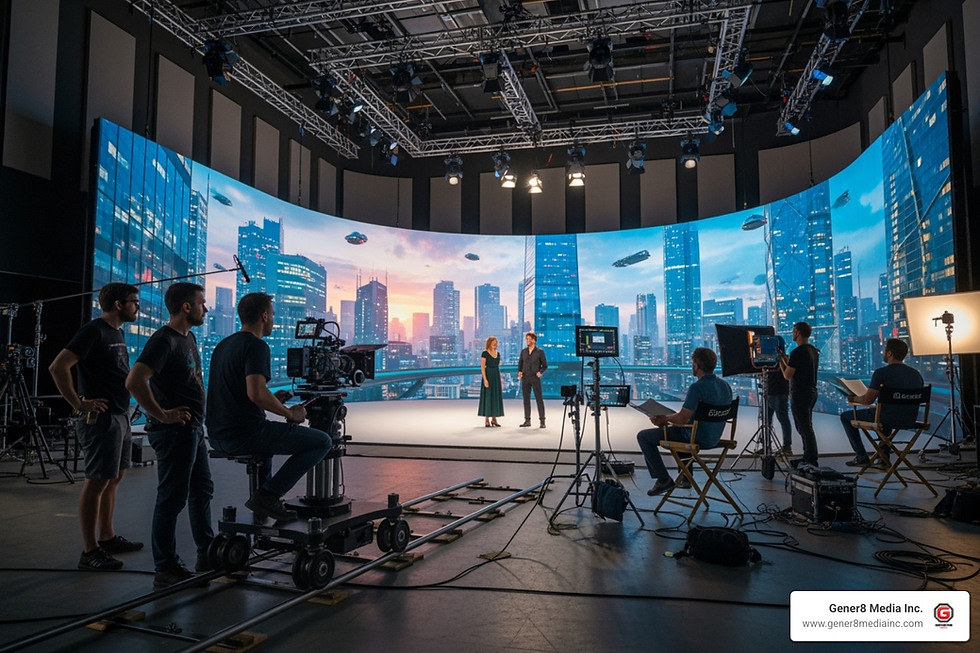
Technology is revolutionizing documentary film production, and AI has become a powerful creative partner. At Gener8 Media, we explore how cutting-edge tools like virtual production and 3D animation can transform visions into immersive experiences.
AI-powered tools streamline post-production workflows in remarkable ways.
Automated transcription converts audio to text in minutes, while AI-assisted noise reduction and color correction save valuable time. Some tools can even analyze footage to identify emotionally impactful moments.
While AI will never replace a skilled editor's creative vision, it acts as a powerful assistant. It frees up time for the nuanced storytelling work—pacing, emotion, and meaning—that only humans can provide. We are constantly learning how these emerging tools can help us serve the story and create deeper connections with our audiences.
From Reel to Real World: Distribution, Careers, and Growth
Completing your documentary is just the beginning. Getting your film seen by the right audiences is where the magic of documentary film production truly comes to life. The distribution landscape has exploded with opportunities, and our approach starts with understanding your goals. Are you aiming to spark social change, build a career, or share a personal story?
How to Distribute and Share Your Documentary
The film festival circuit, including prestigious events like the Sundance Film Festival, is a fantastic launchpad for generating buzz and opening doors. Beyond festivals, sales agents can help pitch your film to major streaming platforms like Netflix and Amazon Prime.
For filmmakers seeking more control, online platforms and direct distribution are viable options, allowing you to reach niche audiences. One of the most rewarding approaches, especially for social issue films, is organizing community screenings and impact campaigns. These events can spark real conversations and lead to actionable change. The key is to match your distribution strategy to your film's goals and your target audience's viewing habits.
Career Paths and Professional Development
Documentary film production offers rewarding career paths for passionate storytellers. The industry recognizes the specialized skills required with competitive salaries. Camera operators average $63,230, film and video editors around $50,310, and producers and directors about $60,490. In Northern California, where Gener8 Media is based, these figures are often higher.
However, documentary careers are driven by more than a paycheck; they're fueled by the stories we tell and the impact we can have. Networking within the film community is essential, as relationships matter enormously.
Film labs and mentorship programs, like those offered by the Sundance Institute, are game-changers for emerging filmmakers. Their Documentary Producers Lab and Track provide project-specific support, critical feedback, and strategic guidance from industry veterans. These programs help transform not just projects, but entire careers. The documentary field rewards those who stay curious, keep learning, and remain open to new approaches and technologies.
Frequently Asked Questions about Documentary Film Production
What makes a documentary film successful and impactful?
A successful documentary connects with viewers emotionally and intellectually. It needs a compelling story, relatable characters facing clear challenges, and high emotional stakes. The best films don't just present facts; they engage hearts and minds through authentic storytelling and high production quality, sparking conversations and inspiring action.
How do you find a compelling story for a documentary?
Start by following your passions and staying curious about the world. Great stories often have built-in conflict and high stakes, featuring unique characters facing significant challenges. The most profound narratives are found through deep research, extensive interviews, and by listening closely to the people and communities around you. The key is to stay open to where the story leads.
What are the essential stages of documentary filmmaking?
Documentary film production follows three essential stages:
Pre-Production: This is the planning phase. It includes story development, research, scripting, budgeting, securing funding, and handling legal preparations like releases and permits.
Production: This is the filming stage. It involves shooting interviews, capturing B-roll footage to provide context, and recording high-quality audio.
Post-Production: This is where the story is crafted. It includes editing the footage and audio, adding music and sound design, color grading, and creating the final film.
Conclusion: Tell the Story Only You Can Tell
Making a documentary is a treasure hunt for truth. The journey of documentary film production takes you from the spark of an idea in pre-production, through the chaos of filming, to the meticulous craft of shaping a narrative in post-production.
The challenge is real, with funding problems, technical setbacks, and the pressure to tell an authentic story. But the reward is even more real. When your film sparks a conversation, changes a perspective, or inspires action, you realize the true power of what you've created.
The future of documentaries is bright. Advancing technology like AI and virtual production is opening new creative possibilities, but it will never replace the human heart at the center of every great documentary.
At Gener8 Media, based in Northern California, we've seen how blending passion with technology can transform ideas into extraordinary films. We use cutting-edge tools to help storytellers bring their unique visions to life.
No one else can tell your story the way you can. Your perspective, your passion, and your voice are what will make your documentary special. The skills can be learned, but your voice is irreplaceable.
Ready to turn your vision into reality? Start your documentary production journey with us and let's create something meaningful together.


Comments